
- Key Takeaways
- Introduction
- The Headline Numbers at a Glance
- What "Provisional" and "In Development" Mean
- Net Migration by Nationality
- Why Net Migration Fell: The Reasons and the Rules Behind Them
- Work Visas: Fewer New Arrivals, More People Extending
- Sponsor Licence Revocations Almost Tripled
- Settlement at Its Highest Since 2010 and Record Citizenship Applications
- Study and Graduate Figures
- Family Visas
- Asylum in Brief
- What These Figures Do Not Mean
- What to Do Now
- How Can WorkPermitCloud Help?
- Conclusion
- Glossary
- Frequently Asked Questions
Key Takeaways
- UK net migration fell to 77,000 in the year ending June 2026. The Office for National Statistics (ONS) published this provisional estimate on 26 November 2026. It is the lowest recorded estimate since 1997 outside the COVID-19 period, down from an updated 204,000 a year earlier and from a peak of 944,000 in the year ending March 2023.
- No immigration rule changed on 26 November 2026. These are statistics, not law. Visa, sponsor licence and settlement rules are exactly as they were the day before, and the latest Statement of Changes to the Immigration Rules is still HC 584 of 3 September 2026.
- The 77,000 figure is provisional and will be revised. The ONS gives a 90% revision-based range of 31,000 to 128,000, labels the series "official statistics in development" and is due to publish its next estimates on 27 May 2027.
- Fewer people arrived, while the number leaving held steady. Immigration fell 17% to 738,000. Emigration was broadly stable at 661,000, against 689,000 a year earlier.
- Only non-EU+ nationals added to the population. Their net migration was 258,000 (down from 379,000), while more British nationals (minus 137,000) and EU+ nationals (minus 45,000) left the UK long term than arrived.
- New work visas have fallen sharply, but people already here are extending their stay in large numbers. In the year ending September 2026, Health and Care Worker visas fell 44% to 30,773 and Skilled Worker visas fell 27% to 56,521, while Health and Care Worker extensions rose 15% to 342,126 and Skilled Worker extensions rose 8% to 198,442.
- Skilled Worker sponsor licence revocations almost tripled, from 1,856 to 5,194. That is the Home Office count for the year ending September 2026 against the year before. The figures include administrative revocations, but every sponsor should treat this as a reason to check its compliance now.
- Settlement grants reached 241,000, the highest since 2010, and citizenship applications hit a record 320,000. The Home Office links the settlement rise mainly to Skilled Worker (including Health and Care Worker) and British National (Overseas) visa holders becoming eligible after five years.
- If you are on a five-year route to ILR, the current rules still apply. The plan to make 10 years the standard qualifying period (CP 1707, published 2 November 2026) is government policy, not law, and falling net migration has not changed it. Separately, Skilled Worker ILR applications made on or after 26 March 2027 need B2 English.
- Our Sponsorship duties service checks whether your records would survive a Home Office compliance visit. With revocations at 5,194 in a year, that is the step to take before an inspection, not after. If you are close to five years, our ILR 5 year route service prepares your settlement application under the current rules.
Introduction
On 26 November 2026 the ONS and the Home Office published their latest migration statistics on the same day. The ONS bulletin, Long-term international migration, provisional: year ending June 2026, puts net migration at 77,000. The Home Office release, Immigration system statistics, year ending September 2026, shows how many visas, extensions, settlement grants and citizenship grants were issued over a slightly different 12-month period.
If you saw the headlines and wondered whether anything has changed for you, the short answer is no. Statistics describe what has already happened. They do not change the Immigration Rules, your visa conditions, your sponsor duties or the date you can apply for indefinite leave to remain (ILR). Every rule that applied on 25 November 2026 still applies today.
This post sets out what the figures actually show, in plain English, with four charts and the tables behind them. It explains which numbers are firm and which are provisional, which policy changes drove the fall (with the date of each), and what the figures do not mean. It ends with what employers, sponsored workers, students and people heading for ILR or British citizenship should do now.
Everything below comes from the ONS and Home Office publications themselves. Where we have done our own arithmetic from their tables, we say so. If you read our post on the previous year's Home Office statistics, you will see how much has moved in 12 months.
The Headline Numbers at a Glance
The ONS measures long-term migration: people moving to or from the UK for 12 months or more. Net migration is immigration minus emigration. Each figure covers a rolling 12-month period, so "year ending June 2026" means 1 July 2025 to 30 June 2026.
| Measure | YE June 2025 (updated) | YE June 2026 (provisional) | Change | Recent peak |
|---|---|---|---|---|
| Immigration | 893,000 | 738,000 | Down 17% | 1,469,000 (YE March 2023) |
| Emigration | 689,000 | 661,000 | Broadly stable | Not stated by the ONS |
| Net migration | 204,000 | 77,000 | More than halved | 944,000 (YE March 2023) |
Source: ONS, Long-term international migration, provisional: year ending June 2026, published 26 November 2026.
The ONS 90% revision-based ranges for the latest year are 31,000 to 128,000 for net migration, 696,000 to 788,000 for immigration and 622,000 to 702,000 for emigration. In other words, the ONS expects the revised figure to land somewhere in those ranges, most likely close to the published estimate.
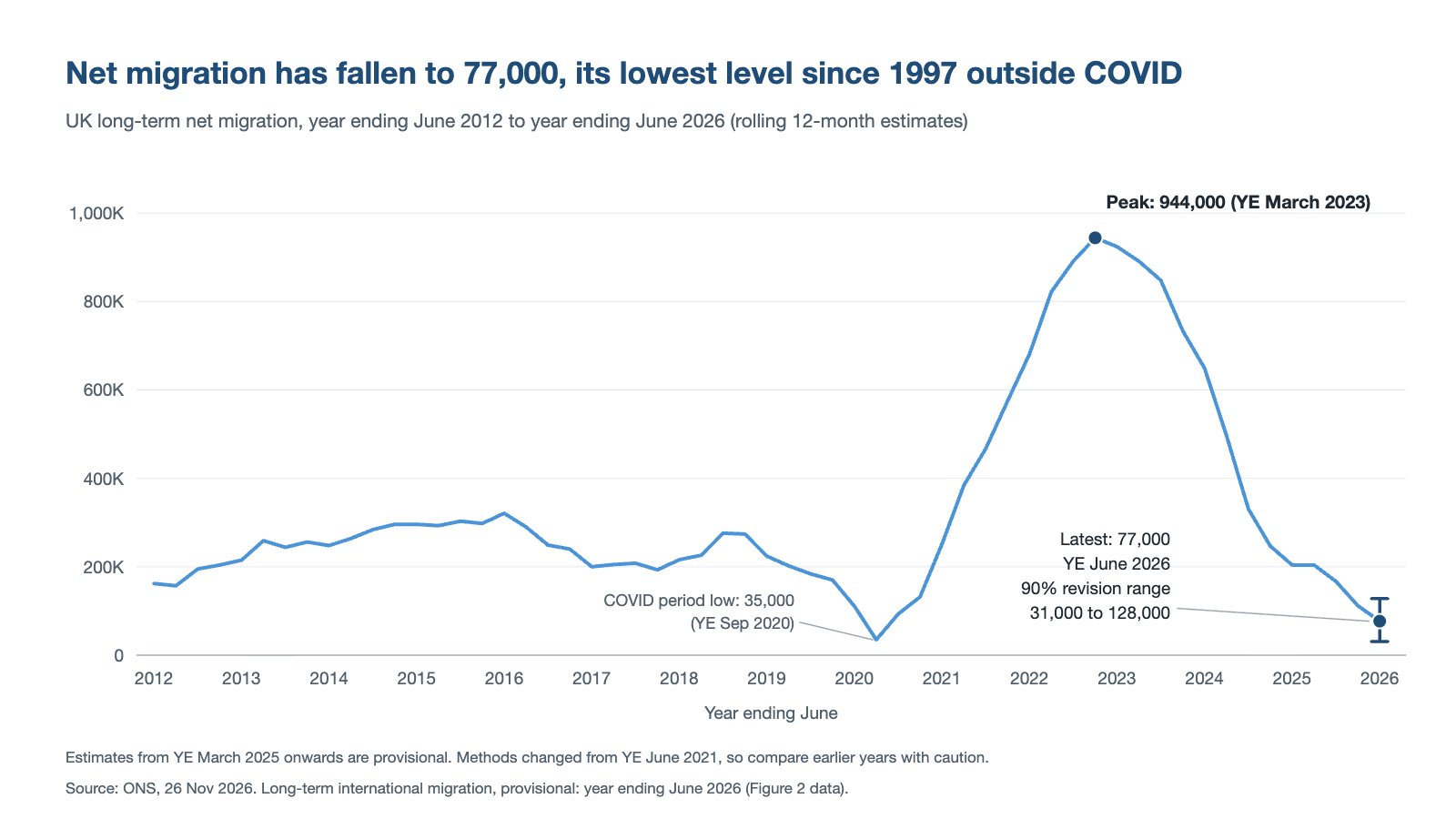
The ONS time series also shows why the ONS says "excluding the COVID-19 period". In the year ending September 2020, when international travel was restricted, net migration dropped to 35,000. Outside that period, 77,000 is the lowest recorded estimate since 1997. The ONS measured migration with surveys in 1997, and its methods changed again from the year ending June 2021, so long-range comparisons should be read with care.
What "Provisional" and "In Development" Mean
Four caveats sit behind the headline, and the ONS states all of them.
- Provisional means it will change. The latest estimates normally stay provisional for about a year, until fuller travel data allows the ONS to replace them. The year ending June 2025 figure has already been revised to 204,000.
- The range is not a confidence interval. The ONS now publishes revision-based intervals, which model how past estimates have been revised. They show a likely range for future revisions, not the sampling error of a survey.
- British figures carry extra uncertainty. Updated tax and benefit data for British nationals was not available, so the ONS projected British estimates forward using a model. It says these carry a higher risk of revision.
- These are "official statistics in development". The ONS is still developing its methods. The Home Office figures, by contrast, are accredited official statistics drawn from its own visa and casework records.
The ONS also notes that Home Office visa grants can show trends in arrivals, but cannot show the net effect, because they do not capture how long people stay or when they leave. The two releases answer different questions, which is why their numbers do not match.
Net Migration by Nationality
The fall is almost entirely a non-EU+ story. EU+ means the 27 EU countries plus Norway, Iceland, Liechtenstein and Switzerland. Non-EU+ means everyone else, excluding British nationals.
| Nationality group | Immigration | Emigration | Net migration YE June 2026 | Net migration YE June 2025 |
|---|---|---|---|---|
| Non-EU+ nationals | 550,000 | 292,000 | 258,000 | 379,000 |
| British nationals | 109,000 | 245,000 | Minus 137,000 | Minus 125,000 |
| EU+ nationals | 79,000 | 124,000 | Minus 45,000 | Minus 51,000 |
| Total | 738,000 | 661,000 | 77,000 | 204,000 |
Source: ONS, 26 November 2026. Figures are rounded to the nearest thousand, so rows may not sum exactly.
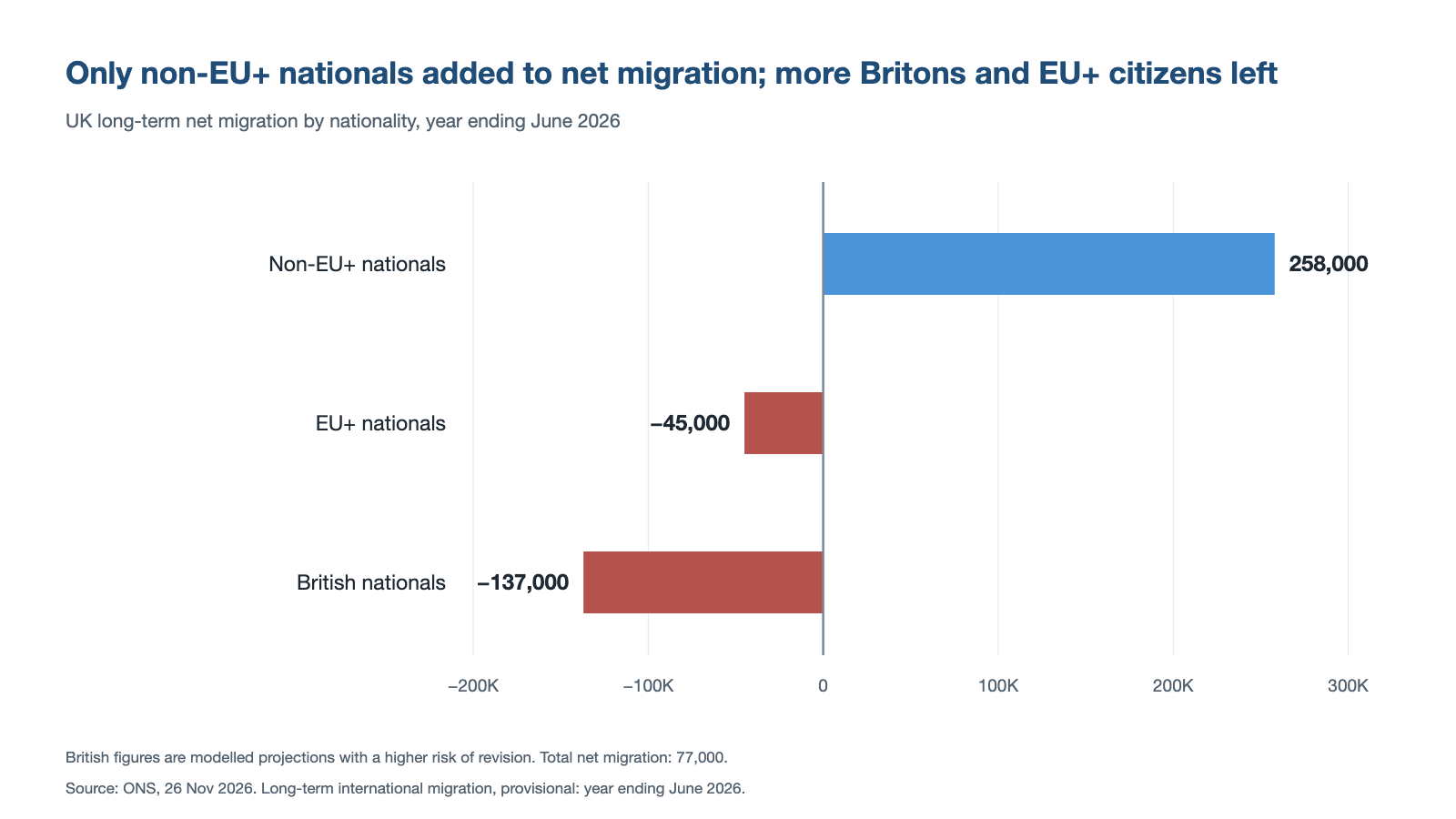
Non-EU+ immigration fell by more than 100,000 to 550,000, while non-EU+ emigration stayed broadly stable at 292,000. That combination is the main reason net migration fell. EU+ net migration has been negative since the year ending June 2022, and more British nationals continue to leave than return.
Why Net Migration Fell: The Reasons and the Rules Behind Them
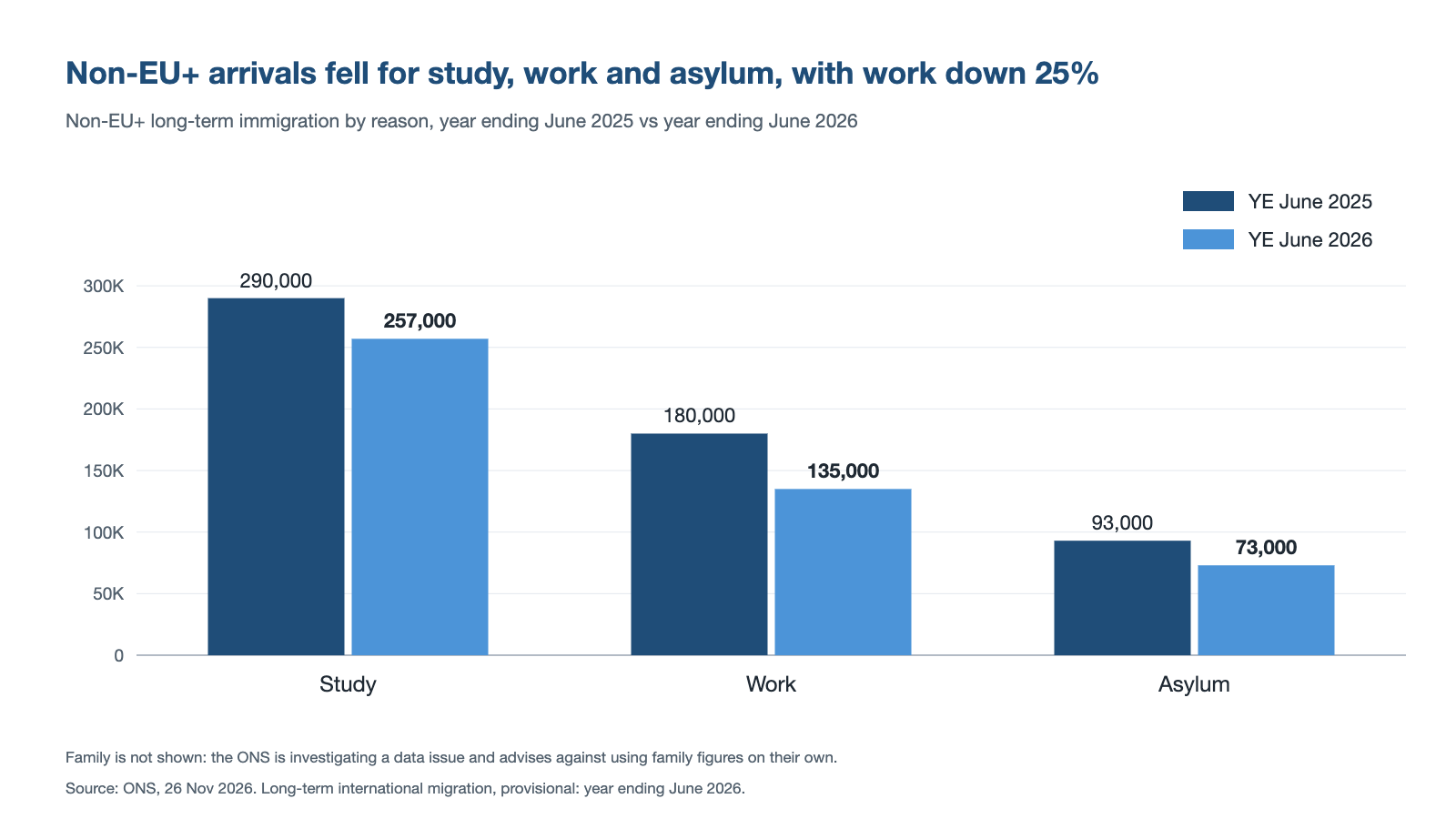
The ONS breaks down non-EU+ immigration by the reason people first came: study, work, asylum and others. Study, work and asylum arrivals all fell over the year.
| Reason for coming (non-EU+) | YE June 2025 | YE June 2026 | Change | Detail |
|---|---|---|---|---|
| Study | 290,000 | 257,000 | Down 11% | Main applicants 242,000 (down 12%); dependants stable at 15,000 |
| Work | 180,000 | 135,000 | Down 25% | Main applicants 60,000 (down 30%); dependants 75,000 (down 21%) |
| Asylum | 93,000 | 73,000 | Down 19,000 on unrounded figures | Includes people who claimed after arriving on a visa and by illegal entry routes |
Source: ONS, 26 November 2026. Family is excluded; see below.
Why there is no family figure
The ONS is working with the Home Office to investigate a data issue that affects its estimates of family immigration and emigration. It advises that family figures should not be used on their own to inform decisions until this is resolved, so we have not quoted a family net migration figure. The Home Office's family visa grants, which are not affected by this issue, are covered further down.
People leaving: students and workers who came earlier
On the other side of the ledger, 155,000 non-EU+ nationals who originally came to study left the UK in the year ending June 2026. The ONS links this to the large numbers of students who arrived in 2022 and 2023 and have since finished their studies and post-study work. A further 85,000 who originally came for work left, including 53,000 main applicants (up 14%) and 32,000 dependants (up 12%).
Putting the two ONS work figures side by side gives a striking result. On our arithmetic from the ONS tables, not an ONS figure, about 60,000 non-EU+ work main applicants arrived and about 53,000 left, a net gain of roughly 7,000. These are rounded estimates of different people, so treat the comparison as an indication only.
The dated policy changes behind the fall
The Home Office keeps a policy and legislative changes timeline alongside its statistics. These are the entries most closely linked to the falls in study, work and family arrivals.
| Date | Change (as recorded by the Home Office) | Route affected |
|---|---|---|
| 1 January 2024 | Only research-based postgraduate students can bring dependants, for courses starting on or after this date | Study |
| 11 March 2024 | Overseas care workers and senior care workers stopped from bringing dependants | Health and Care Worker |
| 4 April 2024 | Skilled Worker general salary threshold raised from £26,200 to £38,700 | Skilled Worker |
| 22 July 2025 | Skills threshold raised to RQF 6, interim Temporary Shortage List introduced, salary thresholds raised, and adult social care applications from overseas closed | Skilled Worker and Health and Care Worker |
| 4 September 2025 | Refugee Family Reunion paused for new applications made after 15:00 | Family |
| 1 June 2026 | Basic Compliance Assessment for student sponsors tightened | Study |
Source: Home Office, Policy and legislative changes affecting migration to the UK: timeline, updated 26 November 2026.
The Home Office also says that work visa grants began falling at the start of 2024, partly because of more scrutiny of employers in the health and social care sector and compliance action against employers who did not meet their duties. For chefs and other hospitality roles, our post on chefs, bar managers and bakers losing Skilled Worker eligibility from 22 July 2025 explains which jobs left the route.
Work Visas: Fewer New Arrivals, More People Extending
The Home Office work chapter covers the year ending September 2026. It shows a sharp fall in new work visas issued from abroad, alongside a rise in extensions for people already in the UK.
| Route | Type | YE September 2026 | Change on previous year |
|---|---|---|---|
| All work visas (including dependants) | New visas | 229,637 | Down 16%; 63% below the YE December 2023 peak of 613,627 |
| Health and Care Worker | New visas | 30,773 | Down 44% |
| Health and Care Worker, main applicants | New visas | 6,725 | Down 59% (peak 145,823 in YE December 2023) |
| Health and Care Worker, caring personal service | New visas | 54 | Down from 107,772 in YE December 2023 |
| Skilled Worker | New visas | 56,521 | Down 27% (main 25,046; dependants 31,475) |
| Skilled Worker, food preparation and hospitality trades | New visas (main) | 128 | Down 93% |
| Skilled Worker, IT professionals | New visas (main) | 4,557 | Down 10%; still the top occupation |
| Seasonal Worker | New visas | 41,484 | Up 8% |
| Youth Mobility Scheme | New visas | 19,973 | Down 6% |
| Health and Care Worker | Extensions | 342,126 | Up 15% |
| Skilled Worker | Extensions | 198,442 | Up 8% |
| Graduate | Extensions | 162,881 | Down 31% |
Source: Home Office, Immigration system statistics, year ending September 2026, Work chapter.
Health and Care Worker visas
Dependants made up 78% of Health and Care Worker visas granted in the latest year. The Home Office says this may partly reflect family members joining workers who were sponsored before the July 2025 changes and can still bring family from abroad. Care worker grants fell by over 99% after the route closed to new overseas recruitment of care workers in July 2025. If you are a care worker already in the UK, our guide to care worker ILR after five years and our Health and Care visa service cover your next steps.
Skilled Worker visas and the July 2025 occupation changes
Over 100 occupations stopped being eligible for the Skilled Worker route from 22 July 2025, after the skill level requirement rose. Food preparation and hospitality trades account for most of the fall in main applicants. The Home Office also reports that applications for "Worker" visas (the long-term sponsored routes, including Skilled Worker and Health and Care Worker) fell to 127,538 (down 76% since the year ending December 2023) and that the share of decisions that were refusals rose from 7% to 13% over the same period.
Why extensions are rising while new visas fall
The gap is a timing effect. Large numbers of people arrived on work visas in 2022 and 2023. Many are now extending their stay, and the Home Office says many of those extending probably entered before the 2024 policy changes. So the system is seeing fewer new arrivals from abroad and more people already here renewing. If you are one of them, our Skilled Worker visa service handles extensions and changes of employer.
Sponsor Licence Revocations Almost Tripled
The Home Office reports that 5,194 Skilled Worker sponsor licences were revoked in the year ending September 2026, compared with 1,856 in the year ending September 2025. The data sits in table SC_01 of the Sponsorship transparency data. We checked the quarterly figures there: 1,516 (October to December 2025), 1,545 (January to March 2026), 801 (April to June 2026) and 1,332 (July to September 2026), which add up to 5,194.
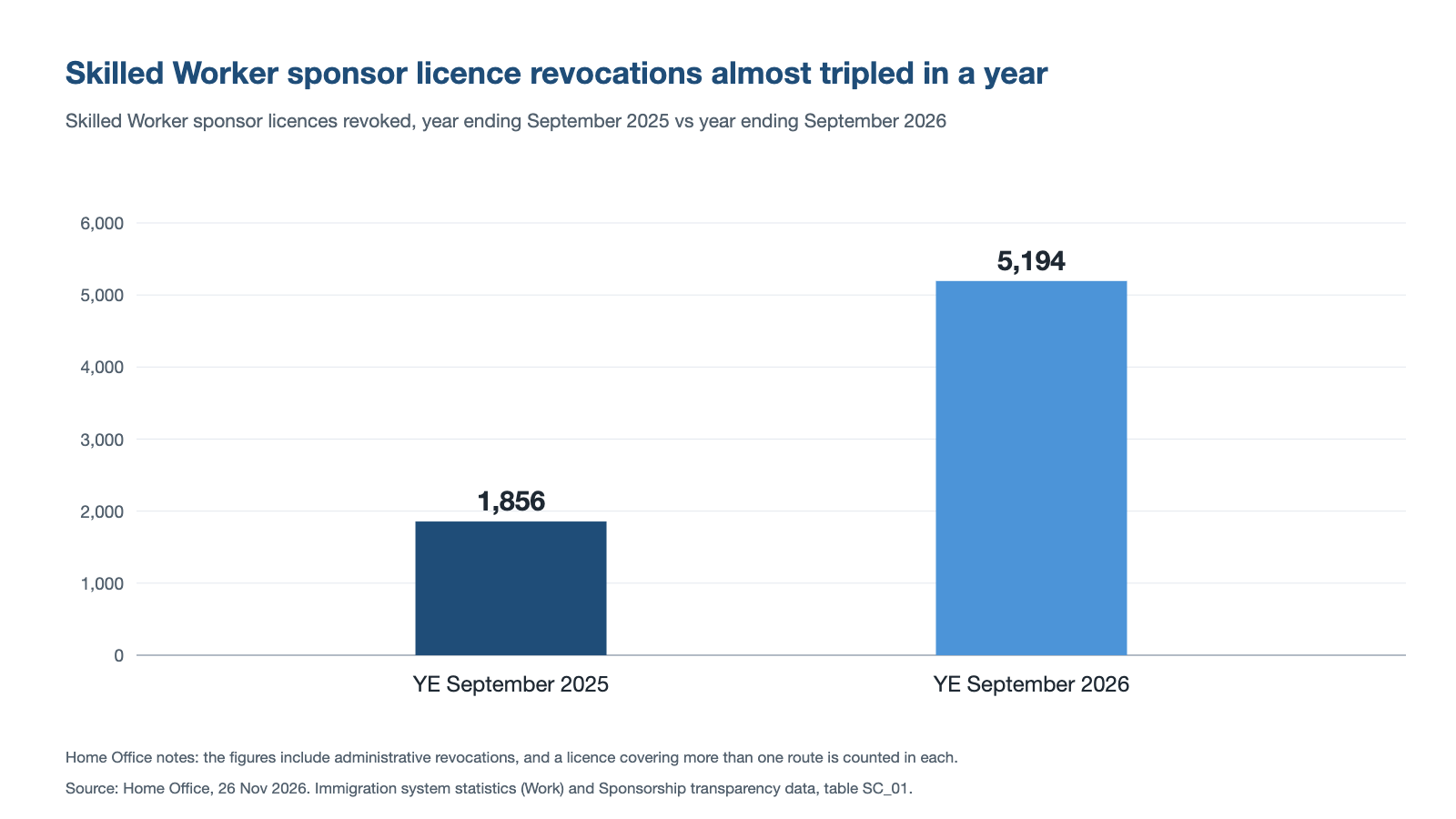
Two notes from the Home Office table matter when you read these numbers. The figures include administrative revocations, and a licence that covers more than one route is counted under each route. The Home Office places the rise "alongside" its policy changes and does not give a breakdown of reasons, so we do not speculate further.
What this means for employers
Whatever the mix of reasons, the risk to a sponsor is the same. A revoked licence means you cannot sponsor anyone, and your sponsored workers' permission can be cut short. The practical steps are:
- Audit your sponsor files now, not when the Home Office calls. Check right to work records, job descriptions, pay against the certificate of sponsorship, and reporting deadlines on the sponsor management system.
- Use our free HR compliance audit as a first check. It flags the gaps most often found on compliance visits.
- Know what suspension and revocation involve. Our sponsor licence suspension and revocation guide explains the process and your response window.
- Plan recruitment around the rules as they stand. Since 22 July 2025, a role below RQF 6 generally has to appear on the Temporary Shortage List, unless the rules for workers already sponsored before that date apply. Our sponsor licence service can check this before you issue a certificate.
If you are a sponsored worker whose employer has lost its licence, get advice straight away, because your permission to stay can be cut short. If you are a care worker, read our guide on what to do after a sponsor licence is revoked.
Settlement at Its Highest Since 2010 and Record Citizenship Applications
While new arrivals fell, settlement rose sharply. The Home Office settlement and citizenship chapters give these figures for the year ending September 2026.
| Measure | YE September 2026 | Change |
|---|---|---|
| Settlement grants (excluding EUSS) | 240,921 | Up 53%; highest since YE September 2010 |
| Settlement after Skilled Worker (including Health and Care Worker) leave | 81,927 | Up 90% from 43,042 |
| Settlement after BN(O) leave | 57,040 | Up from 637 |
| Settlement after refugee or protection leave | 25,517 | Down 26% |
| EUSS settled status grants | 302,076 | Down 8% |
| All indefinite leave (settlement, EUSS and immediate settlement) | 544,732 | Up 11% |
| British citizenship applications | 319,759 | Up 17%; a record high |
| British citizenship grants | 265,052 | Up 10%; just below the record 267,475 in YE December 2024 |
Source: Home Office, Immigration system statistics, year ending September 2026, settlement and citizenship chapters.
Why settlement is rising
The Home Office links the increase to people who came on the Health and Care visa (introduced in August 2020) and the Skilled Worker route (introduced in December 2020) becoming eligible for settlement. The BN(O) route for people from Hong Kong opened in January 2021, and many of its earliest arrivals have now completed the five years of continuous residence it requires. Indian nationals were the largest group granted settlement (44,793), and Indian nationals made up 44% of settlement grants after Skilled Worker leave.
Citizenship follows the same wave. The Home Office says the recent rise in grants is likely to reflect, in part, more people having been granted indefinite leave in earlier years. Applicants based on residence must normally have lived in the UK for at least five years and held indefinite leave for at least 12 months; spouses and civil partners of British citizens have a three-year residence period and can apply as soon as they have indefinite leave.
What it means if you are still on the five-year route
Under Appendix Skilled Worker as it stands today, rule SW 21.1 still requires a continuous period of five years in the UK for settlement. The government's response to the earned settlement consultation, CP 1707, published on 2 November 2026, sets out a plan to make 10 years the standard starting point. That plan is policy, not law: no Statement of Changes has been laid since HC 584 on 3 September 2026. Falling net migration has not changed the policy either. The Home Office settlement chapter itself notes the consultation and says it has not affected these statistics.
One change is already law. Under rule SW 22A.1 of Appendix Skilled Worker, Skilled Worker ILR applications made on or after 26 March 2027 must show English at level B2 unless an exemption applies. To see where you stand, use our ILR eligibility calculator and read our posts on the earned settlement decision, chefs and hospitality workers on the 10-year route and the Life in the UK test.
Study and Graduate Figures
The Home Office study chapter shows 335,801 sponsored study visas granted in the year ending September 2026, 23% fewer than the year before and 49% below the peak in the year ending June 2023. Main applicant grants fell 23% to 322,287 and dependant grants fell 33% to 13,514.
Chinese students received the most visas (80,932, or 25% of the total), followed by Indian students (69,855). Grants to Pakistani students fell 72%, Nigerian students 34% and Indian students 29%. From June 2026, the Home Office tightened the Basic Compliance Assessment for student sponsors: a visa refusal rate below 5%, an enrolment rate of at least 95% and a completion rate of at least 85%, rising to 90% in June 2027. The Home Office says some universities have reduced sponsorship in certain countries as a result.
Extensions onto the Graduate route fell 31% to 162,881, driven by an 82% fall in dependant grants (from 67,670 to 12,371). Graduate visa length is also changing. According to GOV.UK's Graduate visa page, the visa lasts 2 years if you apply on or before 31 December 2026 and 18 months if you apply on or after 1 January 2027, with 3 years for PhD and other doctoral graduates. Our Student visa service supports applicants and switches.
Family Visas
The Home Office family chapter records 55,687 family visas in the year ending September 2026, down 17%. Most of the fall came from Refugee Family Reunion, which dropped 55% to 9,183 after new applications were suspended from 4 September 2025. Partner visas rose 4% to 40,759 and remain 73% of family visas. Family-related extensions rose 39% to 82,424, mostly partners extending their stay.
Asylum in Brief
Asylum is a separate system and not the main question for most of our readers, so we keep it short. In the year ending September 2026, 74,000 people claimed asylum, a third fewer than the year before. Illegal entry routes, most of them small boat arrivals, remained the most common route, accounting for just under half (49%) of asylum seekers. The grant rate at initial decision fell to 38%, the lowest since 2018. At the end of September 2026, 41,000 people were waiting for an initial decision, down 49% on a year earlier.
What These Figures Do Not Mean
| You may have heard | What the figures actually show |
|---|---|
| Net migration is down, so the rules will be relaxed | Nothing in either publication says so. No rule changed on 26 November 2026, and there is no announcement of any relaxation. |
| The 10-year ILR plan has been dropped | No. CP 1707 (2 November 2026) still stands as government policy. It is not yet law, and the falling numbers have not changed it. |
| Net migration is exactly 77,000 | It is a provisional estimate with a 90% revision-based range of 31,000 to 128,000. It will be revised, starting in May 2027. |
| The UK has stopped issuing work visas | 229,637 work visas were still granted in the year ending September 2026, and work extensions totalled 746,125. |
| Fewer people are coming, so sponsors face less scrutiny | Skilled Worker licence revocations rose from 1,856 to 5,194 in a year. |
| The ONS and Home Office numbers contradict each other | They measure different things over different periods. Visa grants are not the same as people staying 12 months or more. |
What to Do Now
Employers and sponsors
Check your compliance before the Home Office does. Review every sponsored worker's file, confirm pay matches the certificate of sponsorship, and check reporting deadlines. Plan future recruitment around the eligible occupation list as it stands, not around headlines. Our Sponsorship duties service reviews your records and processes against the sponsor guidance.
Sponsored workers
Diary your visa expiry date and start an extension early. If you are changing employer, make sure the new sponsor holds a valid licence before you resign. Keep payslips and your certificate of sponsorship details, because they are the evidence for both extension and settlement.
People heading for ILR or citizenship
Work out your five-year date under the current rules, and apply as soon as you qualify. If your date falls on or after 26 March 2027, book a B2 English test in good time. Once you have ILR, citizenship by residence normally needs 12 months with indefinite leave first. Our ILR 5 year route and British citizenship services handle both applications.
Students and graduates
If you plan to apply for the Graduate visa and are eligible now, applying on or before 31 December 2026 gives you 2 years rather than 18 months. Check that your course completion has been reported to the Home Office before you apply.
How Can WorkPermitCloud Help?
WorkPermitCloud is an IAA-regulated immigration adviser (F202100311) that audits UK employers' sponsor licence compliance and prepares ILR and visa applications for sponsored workers. With Skilled Worker revocations at 5,194 in the year ending September 2026, our Sponsorship duties service reviews your right to work checks, pay records, job descriptions and reporting against the Home Office sponsor guidance, and tells you what to fix before a compliance visit.
For workers, our ILR 5 year route service checks your qualifying date, absences and salary under the current rules and prepares your settlement application. We also handle Skilled Worker extensions, Health and Care visas and British citizenship applications.
| Get in touch with our team via our contact page. 📞 Call us: +44 020 8087 2343 📧 Email: info@workpermitcloud.co.uk 📅 Book a consultation: workpermitcloud.co.uk/contact |
Conclusion
The 26 November 2026 figures confirm a large and fast fall in net migration, from 944,000 at the peak to a provisional 77,000. The fall comes from fewer people arriving from outside the EU for work and study, while departures have held steady. Behind it sit dated policy changes from January 2024 to July 2025.
For people already in the system, the picture is different. Extensions, settlement grants and citizenship applications are at or near record levels, and sponsor licence revocations have almost tripled. None of this changes a single rule. The current five-year route to ILR still applies, the earned settlement plan still stands as policy, and the 77,000 figure will be revised. Plan around the rules as they are today.
Glossary
| Term | Definition |
|---|---|
| Net migration | Long-term immigration minus long-term emigration. A positive figure means more people arrived than left. |
| Long-term migrant | Someone who moves to or from the UK for 12 months or more, in line with the United Nations definition. |
| Provisional estimate | An early ONS figure that will be revised when fuller data becomes available, usually within about a year. |
| Revision-based interval | The ONS range within which it expects a revised estimate to fall, based on past revisions. It is not a confidence interval. |
| Official statistics in development | An ONS label for statistics whose methods are still being developed and tested. |
| Accredited official statistics | Statistics assessed as meeting the standards of the Code of Practice for Statistics, such as the Home Office release. |
| EU+ / non-EU+ | EU+ is the EU plus Norway, Iceland, Liechtenstein and Switzerland. Non-EU+ is everyone else, excluding British nationals. |
| Year ending (YE) | The 12 months up to and including the named month. YE September 2026 is 1 October 2025 to 30 September 2026. |
| Main applicant / dependant | The person who holds the visa in their own right, and the partner or child who comes with or joins them. |
| Extension of stay | Permission granted to someone already in the UK to stay longer or switch to another route. |
| Sponsor licence revocation | The Home Office cancelling an employer's licence, so it can no longer sponsor workers. |
| SC_01 | The Home Office sponsorship transparency table recording suspensions and revocations of sponsor licences. |
| Settlement / ILR | Indefinite leave to remain: permission to live in the UK with no time limit. |
| EUSS settled status | Indefinite leave granted under the EU Settlement Scheme. |
| BN(O) | British National (Overseas). A status for some people from Hong Kong, with its own UK visa route since January 2021. |
| Naturalisation | Becoming a British citizen as an adult, usually after holding ILR. |
| RQF 6 | Degree-level skill. Since 22 July 2025, Skilled Worker roles generally need to be at this level. |
| CP 1707 | The government's response to the earned settlement consultation, published 2 November 2026. Policy, not law. |
| Statement of Changes | The document laid before Parliament to change the Immigration Rules. The latest is HC 584 of 3 September 2026. |
| Basic Compliance Assessment | The annual test that licensed student sponsors must pass on refusal, enrolment and completion rates. |
| Refugee Family Reunion | The route for partners and children of people with refugee status or humanitarian protection, suspended for new applications from 4 September 2025. |