
- Key Takeaways
- Introduction
- What Has Been Decided and What Is Still Not Law
- The New Settlement Pathways at a Glance
- The Mandatory Requirements Everyone Must Meet
- Care Workers: The Biggest Change From the Original Plan
- Chefs, Butchers and Other Skilled Workers Below RQF 6
- Who Can Still Settle in Five Years or Less
- Good News and Bad News
- Long Residence Closes and Temporary Visas Stop Counting
- Families and Dependants
- Who Is Outside Earned Settlement
- Refugees and Illegal Entry
- What You Should Do Now
- How Can WorkPermitCloud Help?
- Conclusion
- Glossary
- Frequently Asked Questions
Key Takeaways
- The government has made its final decision on earned settlement, but the new rules are not law yet. The Home Office published its response to the consultation (CP 1707) on 2 November 2026, and no Statement of Changes has been laid, so the current five-year rules still apply to every application today.
- Ten years is now the confirmed standard route to settlement for most migrants. You need earnings of at least £12,571 in five of the seven years before applying, B2 English, the Life in the UK test, no criminal record and no unpaid government debt.
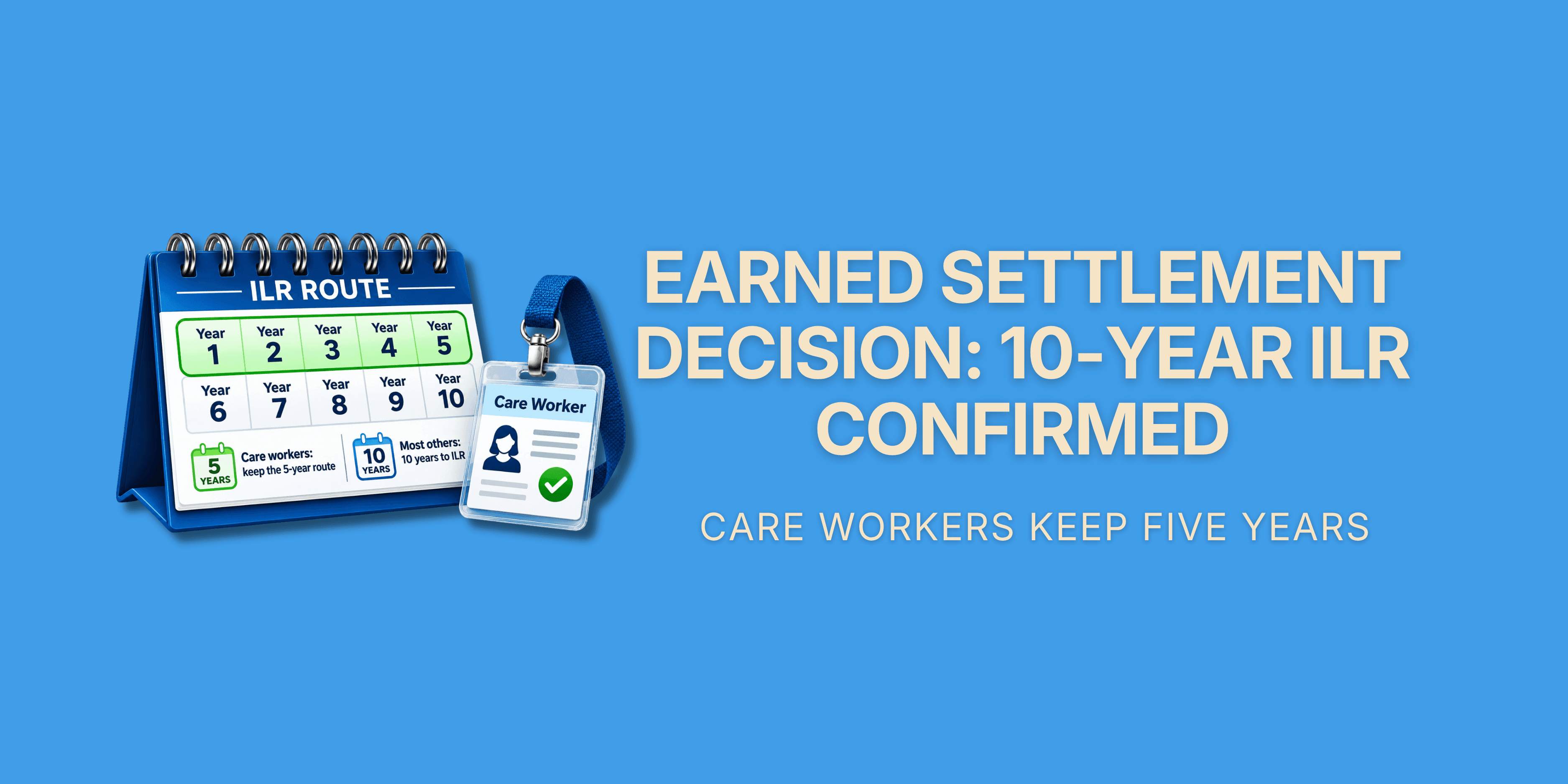
- Care workers who entered or switched into the route before the May 2025 White Paper keep the five-year route. They must meet the £25,000 salary, sponsorship and employment requirements. Those who fall short at five years are not refused outright but get a second chance through a further five-year Health and Care visa, which in practice means settling after about 10 years.
- Care workers who joined the route after May 2025 are on the 10-year route. The transitional protection is tied to the publication of the Immigration White Paper on 12 May 2025, not to the date the new rules start.
- The proposed 15-year route for lower-skilled workers has been dropped. Workers below RQF level 6, including chefs and butchers, go onto the 10-year route instead, and the pre-April 2024 Skilled Worker cohort can keep extending on its old salary terms until 2035.
- High earners and key public servants can still settle in five years or less. Earning £50,271 or more in three of the last five years gives five years, earning £125,141 or more in three of the last four years gives three years, and doctors, nurses, teachers and social workers get five years.
- Partners and children of British citizens stay on a five-year route. UK Ancestry applicants also keep five years, provided they meet the new mandatory requirements.
- Claiming public funds or breaking immigration rules now has a heavy cost. An adult immigration breach such as overstaying puts you on a 20-year route, and accessing specified public funds in the five years before applying means you must either complete five years without them or wait 20 years.
- The 10-year Long Residence route will close, and time on Student and Graduate visas will stop counting. Only time on routes that lead to settlement, such as Skilled Worker, Global Talent and family routes, will build towards ILR.
- If you reach five years before the new rules start, apply on your earliest valid date. Applications are normally decided under the rules in force on the date of decision, and our indefinite leave to remain service can check your dates and prepare the application now.
Introduction
On 2 November 2026 the Home Secretary, Shabana Mahmood, set out the government's final decisions on earned settlement in the House of Commons. On the same day the Home Office published A Fairer Pathway to Settlement: Government Response to the Consultation (CP 1707), a 62-page document that replaces almost a year of proposals and speculation with confirmed policy.
The headline is that the standard wait for indefinite leave to remain (ILR) moves from five years to 10. The biggest change from the original plan is for care workers. Instead of the 15-year wait proposed in November 2025, care workers who entered or switched into the care route before May 2025 keep a five-year route if they meet the salary and sponsorship requirements.
There is one point you must understand before reading further. This is confirmed government policy, not law. The new rules only take effect once the Home Office lays a Statement of Changes to the Immigration Rules before Parliament. As of 2 November 2026 the latest statement in the GOV.UK Statement of Changes collection is still HC 584 of 3 September 2026, which does not change the settlement qualifying period. The government has not given a start date.
This guide explains exactly what was decided, who wins and who loses, how care workers, chefs, families and public service workers are affected, and what you should do now while the current rules still apply.
What Has Been Decided and What Is Still Not Law
The table below separates what the government has confirmed from what still has to happen before anything changes for your application.
| Item | Status on 2 November 2026 |
|---|---|
| Earned settlement framework (10-year standard route) | Confirmed policy in the government response, CP 1707, published 2 November 2026 |
| Statement of Changes to the Immigration Rules | Not laid. The latest statement is HC 584 of 3 September 2026 |
| Start date for the new rules | Not announced |
| Technical guidance and full impact assessment | Promised before implementation, not yet published |
| Detailed rules for vulnerable groups | To be set out in guidance "next year", according to CP 1707 |
| Care worker sponsor revocation grace period (120 + 60 days) | Confirmed policy, stated to apply from 1 February 2027 |
| Current five-year settlement rules | Still in force for every application made now |
The government response also states that, unless transitional provisions say otherwise, applications are ordinarily decided under the Immigration Rules in force on the date of the decision. That is why timing matters so much for anyone who will complete five years in the coming months. We explained the timing risk in our earlier post on what the Home Secretary told MPs about transitional protection.
The New Settlement Pathways at a Glance
Under earned settlement, your qualifying period depends on your contribution, your compliance and the route you are on. Every pathway also requires the mandatory requirements set out in the next section.
| Pathway | Who it is for | Main condition | Disqualified if |
|---|---|---|---|
| 3 years | Exceptional economic contributors | Earned at least £125,141 in 3 of the last 4 years, or qualifies through the highest talent group | Accessed public funds in the last 5 years, or committed a qualifying immigration breach |
| 5 years | Higher earners, public service workers, British connections | Earned at least £50,271 in 3 of the last 5 years, or worked 5 years in an eligible public service occupation, or has a British connection | Accessed public funds in the last 5 years, or committed a qualifying immigration breach |
| 10 years | The default for everyone else who plays by the rules | Earned at least £12,571 in 5 of the last 7 years | Accessed public funds in the last 5 years, or committed a qualifying immigration breach |
| 20 years | People with immigration breaches or recent public funds use | Earned at least £12,571 in 5 of the last 7 years | Not applicable |
The earnings thresholds are tied to UK income tax bands, so they will move automatically if those bands change. Under the "best years" test, a year of maternity leave, illness or caring does not automatically push you onto a longer route. The public funds test will use the existing definition in the Immigration Rules, set out in the Home Office public funds guidance, and the government will confirm which benefits count, and any safeguards, before implementation.
You can check where your own dates currently fall using our free ILR eligibility calculator.
The Mandatory Requirements Everyone Must Meet
These requirements apply on every pathway. Higher earnings or public service cannot offset them.
| Requirement | What CP 1707 says |
|---|---|
| Good character and suitability | Any adult with a UK criminal record will be refused, including cautions with conditions, fines, community sentences and suspended sentences. Overseas convictions also count where the conduct would be a crime in the UK |
| No government debt | No outstanding NHS debt, tax or National Insurance debt, or litigation debt owed to the Home Office |
| English language | B2 level (equivalent to A level in a foreign language). C1 English will not shorten the route |
| Life in the UK test | Still mandatory, and the test is being reviewed |
| Sustained contribution | At least £12,571 a year in the required number of years, or a combined household income of £25,142 for eligible couples |
The criminal record rule is a major tightening. Under the current rules, a sentence under 12 months or an out-of-court disposal leads to discretionary refusal, not automatic refusal. Under earned settlement, any UK criminal record as an adult means refusal.
On English, the move to B2 for settlement was already decided separately and applies from 26 March 2027. Our guide on which English tests UKVI will accept for ILR after 26 March 2027 explains which tests to book.
Children, people aged 65 and over, and people whose physical or mental condition prevents them from meeting a requirement keep the existing exemptions from the income, English and Life in the UK requirements.
Care Workers: The Biggest Change From the Original Plan
The November 2025 consultation proposed that lower-paid workers, including care workers, could wait 15 years for settlement. The government has now decided to treat care workers already in the UK as what CP 1707 calls a "unique cohort".
Care workers who joined the care route before May 2025
If you entered the care worker route, or switched into it, before the Immigration White Paper was published on 12 May 2025, you keep the existing five-year qualifying period. To use it you must meet:
- the £25,000 a year salary requirement;
- the sponsorship and employment requirements of your route; and
- the new mandatory requirements, including the criminality rule and B2 English, unless an exemption applies.
If you do not meet those requirements after five years, you will not qualify for settlement at that point, but you will not lose your route either. You can apply for a further five-year Health and Care visa, restricted to genuine work in the care sector with a licensed sponsor, to give you a second chance to meet the requirements. You will stay subject to no recourse to public funds during that visa. In practice, this means a total wait of around 10 years, and the government counts this group on the 10-year pathway.
The government's own estimate is that around 146,000 care workers and 136,000 dependants could settle through the transitional five-year arrangement, and around 50,000 care workers and 50,000 dependants could need the further visa.
One point to watch for care workers whose partner does not work. A care worker earning £25,000 meets their own salary requirement, but the household income threshold that a non-earning partner relies on is £25,142, so that partner may fall £142 short. CP 1707 does not deal with this case directly, and the detailed rules may clarify it.
Care workers who joined after May 2025
If you entered or switched into the care worker route after the White Paper was published, the transitional protection does not apply. You go onto the standard 10-year earned settlement route. The Home Office estimates this affects around 6,000 care workers and 5,000 dependants.
More time if your sponsor loses its licence
From 1 February 2027, care workers whose sponsor's licence is revoked will have up to 120 days to secure a new job offer, and a further 60 days to resolve their visa and employment status. If they cannot secure a job offer within 120 days, or resolve their status within 180 days, their visa will be curtailed. This is longer than the 60 days given to other sponsored workers. Our guide for care workers whose sponsor licence has been revoked explains the current process.
| Care worker situation | Settlement position under CP 1707 |
|---|---|
| Entered or switched into the route before 12 May 2025, meets £25,000 salary and sponsorship requirements | Five years |
| Joined before 12 May 2025, does not meet the requirements at five years | Further five-year sponsored Health and Care visa, then apply again (around 10 years in total) |
| Entered or switched in after 12 May 2025 | 10 years (standard earned settlement route) |
| Sponsor licence revoked, from 1 February 2027 | 120 days to find a job offer plus 60 days to resolve status |
Chefs, Butchers and Other Skilled Workers Below RQF 6
The government has dropped the proposed 15-year route for workers in occupations below RQF level 6. That is good news compared with the consultation. However, there is no special protection for chefs, butchers or similar roles. They go onto the standard 10-year route unless they earn enough for a faster one.
In practice, a chef on a Skilled Worker visa will need 10 years unless they earn at least £50,271 in three of the five years before applying, in which case five years is available. The Home Office estimates that around 146,000 Skilled Workers and 85,000 dependants who were expected to settle between 2026 and 2030 will now be on the 10-year pathway.
There is one helpful measure. Workers who were already in the Skilled Worker route before the April 2024 salary increases were given transitional arrangements to extend under the older, lower salary thresholds, with a sunset date of 2030. Because these workers now face a 10-year route, the government will let them extend their visas on their current terms until 2035.
Chefs who first came to the UK under the rules in force before 22 July 2025 should also read our post on why chefs, bar managers and bakers lost Skilled Worker eligibility from 22 July 2025, as it explains how extensions work for those already in the route.
Who Can Still Settle in Five Years or Less
Higher earners
Earning at least £50,271 in three of the five years before applying gives a five-year route. Earning at least £125,141 in three of the four years before applying gives a three-year route. Our 2026 guide to ILR salary thresholds explains how salary is assessed under the current rules.
Public service workers in health and education
Workers in specified health and education occupations paid on national pay scales qualify for a permanent five-year route. Annex C of CP 1707 lists them, including doctors, nurses, midwives, paramedics, pharmacists, physiotherapists, radiographers, teachers, head teachers and social workers.
There is also a one-off arrangement for health and education workers below RQF 6 on national pay scales, such as nursing auxiliaries and teaching assistants. If they came to the UK before the May 2025 White Paper and meet the requirements of their visa, they keep five years. Those arriving after that date go onto the 10-year route.
British connections
Partners, parents and children of British citizens stay on a five-year route, as do Commonwealth citizens on the UK Ancestry route. This element was not subject to consultation and has been confirmed.
Good News and Bad News
| Good news | Bad news |
|---|---|
| Care workers who joined the care route before May 2025 keep five years if they meet the £25,000 salary and sponsorship requirements | The standard route for most migrants doubles from five to 10 years |
| The 15-year route for workers below RQF 6 has been dropped | Chefs, butchers and other workers below RQF 6 get no special protection and face 10 years |
| Partners can combine incomes to meet a £25,142 household threshold | Any UK criminal record as an adult will mean refusal |
| Partners who arrive with the main applicant can settle together | Accessing public funds in the five years before applying means 20 years |
| Children under 18 are exempt from the income, English and Life in the UK requirements | Time on Student and Graduate visas will no longer count, and Long Residence closes |
| A "best years" test protects people who take maternity leave or are ill | More than 500,000 people will settle later than under the current rules, on the Home Office's own estimate |
| Pre-April 2024 Skilled Workers can extend on old salary terms until 2035 | Volunteering will not shorten the route, and C1 English gives no reduction |
Long Residence Closes and Temporary Visas Stop Counting
Under the current rules, someone can settle after 10 years of continuous lawful residence through the Long Residence route, combining time on almost any visa. Under earned settlement, the Long Residence route will close.
Only time on routes intended to lead to settlement will count. These include Skilled Worker, Health and Care, Global Talent, Scale-up, Innovator Founder, UK Ancestry, Minister of Religion, International Sportsperson and family partner routes. Time on the following routes will not count: Visit, Student, Graduate, High Potential Individual, Global Business Mobility, Temporary Worker routes, Youth Mobility, Seasonal Worker, Overseas Domestic Worker and the Ukraine schemes. The treatment of leave outside the rules will be confirmed later.
This is a serious change for international graduates. A student who spent four years studying and two years on a Graduate visa before switching to a Skilled Worker visa currently builds towards Long Residence. Under earned settlement, only the Skilled Worker years will count. Our guide to what counts towards your five-year ILR qualifying period sets out the current position.
Families and Dependants
The government moved away from requiring every family member to earn settlement separately.
| Family member | Settlement position under CP 1707 |
|---|---|
| Partner who arrives with the main applicant | Can settle at the same time, if they meet the requirements |
| Partner who joins later | Must complete the same qualifying period as a dependant |
| Child under 18 | Settles with parents; exempt from income, debt, English and Life in the UK requirements, but criminality rules still apply |
| Young adult aged 18 to 24 with child dependant status | Settles with family; must meet adult requirements except the income requirement |
| Dependant aged 25 or over when the family becomes eligible | Must qualify independently or move onto their own immigration route |
| Couples | Can combine income to meet a £25,142 household threshold; only one partner may rely on the other's income |
If your partner joined you after you arrived, our post on completing five years when your partner joined later explains the current rules, which still apply until the new rules start.
Who Is Outside Earned Settlement
Some groups keep their existing arrangements, although most will still need to meet the new criminality rule and B2 English unless an exemption applies.
- Hong Kong BN(O) visa holders keep five years.
- Afghan schemes keep immediate settlement.
- HM Armed Forces personnel keep settlement after four years' reckonable service.
- The EU Settlement Scheme and the Windrush scheme are not affected.
- Bereaved partners and victims of domestic abuse can still apply for settlement immediately.
- Children in local authority care, unaccompanied asylum-seeking children and young people who have grown up in the UK keep their existing arrangements.
Anyone who already holds ILR is not affected. The Home Secretary confirmed when launching the consultation that the government will not change the rules for people who already have settled status.
Refugees and Illegal Entry
Refugees resettled through designated safe and legal routes, such as the UK Resettlement Scheme, will settle after five years. People granted protection after claiming asylum in the UK will move onto Core Protection, with a 20-year route, or a 10-year route if they move into sustained work or study. Anyone who entered the UK illegally will ordinarily face an additional 10 years, except where Article 31 of the Refugee Convention protects them.
What You Should Do Now
Until a Statement of Changes is laid and comes into force, the current rules apply. The practical steps below depend on where you are.
| Your situation | What to do now |
|---|---|
| You will complete five years before new rules are likely to start | Apply on your earliest valid date under the current rules. Check your dates with an adviser before you apply |
| You are a care worker who joined the care route before May 2025 | Keep evidence of your salary of at least £25,000, your sponsor and your genuine care work. Book a B2 English test |
| Your salary is close to £50,271 | Keep payslips and P60s for every year. Three good years out of five may give you a five-year route |
| You have unpaid NHS charges, tax or National Insurance | Clear them now. Any outstanding government debt will block settlement |
| You have claimed any benefit | Take advice before applying. Recent public funds use could put you on a 20-year route |
| You are on a Student or Graduate visa | Plan your switch to a qualifying route early, as temporary visa time will stop counting |
| You are an employer sponsoring care workers | Check each worker's route entry date and keep salary records audit-ready |
Employers sponsoring care staff should also make sure their sponsor duties are in order. Our free HR compliance audit checks your records against Home Office requirements.
How Can WorkPermitCloud Help?
WorkPermitCloud is an IAA-regulated immigration adviser (F202100311) that prepares and submits indefinite leave to remain applications for Skilled Workers, care workers and their families. We can check exactly when you qualify under the current rules, whether you fall within the care worker or public service transitional protection, and whether your earnings put you on a faster route under earned settlement.
Our ILR five-year route service handles applications that need to be submitted before the rules change, and our ILR 10-year route service supports applicants on longer pathways. For employers, our Health and Care visa service and sponsor licence service keep your workforce compliant while the new rules are finalised.
| Get in touch with our team via our contact page. 📞 Call us: +44 020 8087 2343 📧 Email: info@workpermitcloud.co.uk 📅 Book a consultation: https://www.workpermitcloud.co.uk/contact |
Conclusion
The earned settlement decision answers the biggest question of the last year: the standard route to settlement will be 10 years. The government has softened the plan in important ways, especially for care workers who joined the care route before May 2025, families, and workers below RQF 6, who will no longer face 15 years.
But nothing changes until the Home Office lays new Immigration Rules, and no date has been set. If you can apply for ILR under the current rules before then, that is likely to be your safest option. If you cannot, the time to prepare is now: protect your salary record, clear any government debt, avoid public funds and book your B2 English test.
Glossary
| Term | Definition |
|---|---|
| Indefinite leave to remain (ILR) | Permission to live in the UK permanently without time limits, also called settlement |
| Earned settlement | The new framework where the time to settle depends on contribution, integration and compliance, not time alone |
| Statement of Changes | The document the Home Office lays before Parliament to change the Immigration Rules |
| CP 1707 | The reference number of the government's response to the earned settlement consultation, published 2 November 2026 |
| Qualifying period | The length of time you must spend on a qualifying route before you can apply for settlement |
| RQF level | The Regulated Qualifications Framework level of a job. RQF 6 is degree level |
| B2 English | An upper-intermediate level of English, equivalent to A level in a foreign language |
| Life in the UK test | A test on British history, laws and customs required for settlement |
| Public funds | Specified benefits and housing support listed in the Immigration Rules |
| Long Residence route | The current route to settlement after 10 years of continuous lawful residence, which will close |
| Transitional arrangement | A rule protecting people already in the UK from the full effect of a new rule |
| Immigration White Paper | "Restoring Control over the Immigration System", published 12 May 2025, which first announced the 10-year route |
| Curtailment | When the Home Office shortens a visa so that it ends early |
| No recourse to public funds (NRPF) | A visa condition that stops you claiming most benefits |