
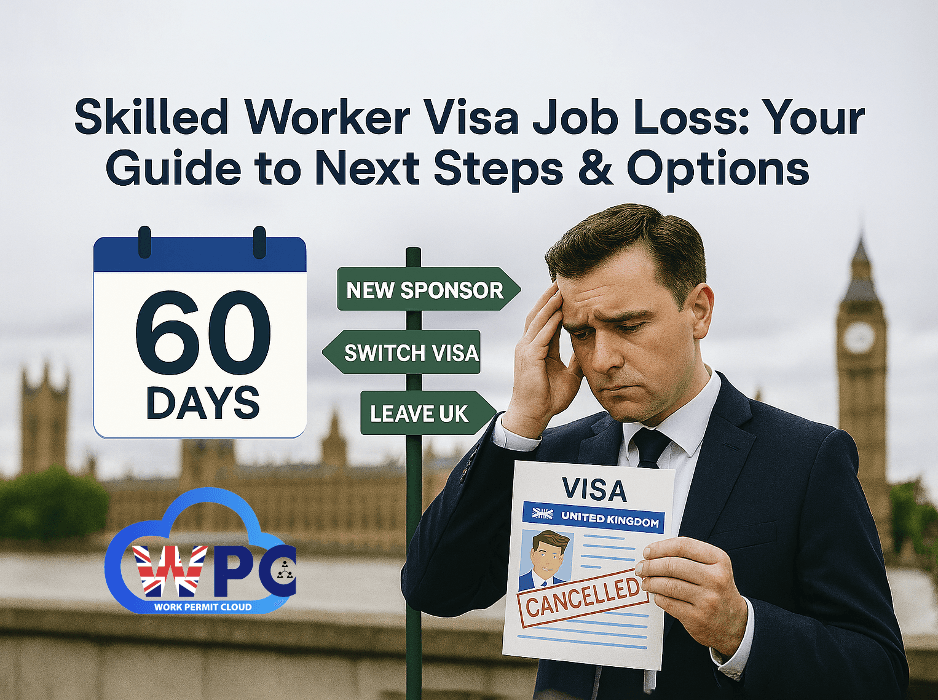
- Introduction
- What Happens to Your Visa When Your Job Ends?
- How Long Do You Have to Act?
- Can You Stay on the Skilled Worker Route?
- Self-Sponsorship: An Option to Consider
- Can You Switch to Another UK Visa Route?
- Will Losing Your Job Affect Your Indefinite Leave to Remain (ILR) Application?
- Can You Travel Outside the UK After Your Employment Ends?
- What Happens If You Overstay?
- What About Dependants?
- How Can WorkPermitCloud Help?
- Conclusion
- Glossary
- Frequently Asked Questions
1. Introduction
Losing your job can be a daunting experience, especially when your right to live and work in the UK is tied to your employment. If you're a Skilled Worker visa holder in the UK and find yourself in this situation, you're likely wondering what happens next and what options are available to you.
This guide is designed to provide you with clear, actionable information on what to do if your sponsored employment ends, helping you navigate this challenging time with confidence.
For the full picture, including what work you can do once your job ends and how transitional protection is affected if you switch route, see our guidance on Skilled Worker: Job Loss and Second Jobs.
2. What Happens to Your Visa When Your Job Ends?
Your Skilled Worker visa is directly linked to your employment with your sponsoring company. If your job ends, for any reason, whether you're made redundant, dismissed, a sponsor licence revocation, or resign, your sponsor has a legal obligation to inform the Home Office within 10 working days via the Sponsor Management System (SMS).
Once the Home Office is notified, it will typically cancel your permission (a process previously called curtailment), meaning it shortens how long your permission lasts. You'll usually receive a letter informing you that you have 60 days to make new arrangements, or until your original visa expiry date, whichever is sooner. Your permission can be cancelled with immediate effect if you stopped working without a reasonable explanation, were dismissed for gross misconduct, or were involved in the reasons your sponsor lost its licence. If 60 days or less of your permission remain, the Home Office normally does not cancel it at all.
It's crucial to understand that your permission to stay in the UK becomes time-limited once your sponsored employment ceases.
3. How Long Do You Have to Act?
As mentioned, after your employer reports the end of your sponsorship, the Home Office will usually cancel your permission so that 60 days remain. The 60 days run from the date the cancellation decision is served on you, not from your last day at work. During this time, you must either:
⧁ Find a new sponsored job and apply for a new Skilled Worker visa.
⧁ Switch to a different immigration route for which you're eligible.
⧁ Make arrangements to leave the UK.
Once your sponsored job ends you cannot work, paid or unpaid, other than genuine voluntary work, until a new application is granted. That includes any second job you had.
Swift action is key during this 60-day window to avoid becoming an overstayer, which can have severe consequences for any future UK visa applications.

4. Can You Stay on the Skilled Worker Route?
Absolutely! The most straightforward path for many is to find a new employer who is willing to sponsor you under the Skilled Worker route. Here’s what you need to know:
◆ New Sponsor Needed:
Your new employer must hold a valid sponsor licence with an A-rating. A B-rated sponsor cannot sponsor a new worker.
◆ New Certificate of Sponsorship (CoS):
They will need to issue you a new CoS, confirming the details of your new role.
◆ New Visa Application:
You will then need to submit a new Skilled Worker visa application to the Home Office before your current visa (or the 60-day grace period) expires.
◆ Genuine Vacancy:
The new job must be a genuine vacancy, meet the appropriate skill level, and satisfy the required salary thresholds.
Important Note on Starting New Employment:
You cannot start your new job until your new Skilled Worker visa application has been approved. However, you can work out any notice period with your old employer while your new application is pending, provided you submitted it before your previous leave expired.
5. Self-Sponsorship: An Option to Consider
Did you know you can also potentially sponsor yourself? If you own, or set up, a genuine UK trading company, that company may be able to obtain a sponsor licence and sponsor you as a Skilled Worker. It needs genuine trading activity, eligible Key Personnel and a role that meets every Skilled Worker requirement, including the skill level, salary and going rate, and the process rarely fits inside a 60-day window. Our guidance on Self-Sponsorship and Founder Routes explains how it works. Your company must:
✔ Obtain a sponsor licence
✔ Offer you a genuine skilled role: Issue your CoS
✔ Secure your Visa
✔ Pay the required salary
This route offers flexibility but involves legal and administrative complexity, so professional support is highly recommended.
6. Can You Switch to Another UK Visa Route?
If finding a new sponsored job isn't feasible, or if your circumstances have changed, you might be able to switch to a different immigration route. Several options could be available, depending on your eligibility:
● Work-related visas:
○ Global Talent visa:
For individuals recognised as leaders or emerging leaders in specific fields (e.g., science, arts, digital technology).
○ Scale-up visa:
For those who have a job offer from a fast-growing UK company with a Scale-up sponsor licence.
○ Innovator Founder visa:
If you have an innovative, viable, and scalable business idea and endorsement from an approved body.
○ High Potential Individual visa:
If you have an overseas degree from a university on the Global Universities List, awarded in the last 5 years, and English at level B2. It is not open to anyone who has held Graduate, High Potential Individual or Doctorate Extension Scheme permission before, it does not lead to settlement, and applications are capped at 8,000 a year (counted from 1 November to 31 October).
● Personal visas:
○ Spouse/Partner visa:
If you have a British or settled partner in the UK.
○ Student visa:
If you receive an offer from a licensed student sponsor and can fund your studies.
○ Dependant of your partner:
If your partner holds their own visa on a route that allows dependants to apply from inside the UK, such as Skilled Worker, you can apply to stay as their dependant. You can then work in almost any job, but time as a dependant does not count towards Skilled Worker settlement. Our guidance on Dependants and Family explains the rules.
Two routes are not open to you from inside the UK. You can only switch to the Graduate route if you hold, or last held, Student permission, and you cannot switch into a visit visa from inside the UK. Switching to any other route also ends your continuous Skilled Worker permission. If you rely on transitional arrangements, for example because you were first sponsored before 22 July 2025 in a job below degree level, you would lose them if you later returned to the Skilled Worker route.
Remember:
Whichever route you consider, you must meet all the eligibility criteria for that specific visa and submit your application before your existing leave expires to avoid overstaying. Once your application is submitted, your permission is protected under Section 3C of the Immigration Act 1971 while you wait for a decision.
7. Will Losing Your Job Affect Your Indefinite Leave to Remain (ILR) Application?
Yes, losing your sponsored job can impact your eligibility for Indefinite Leave to Remain (ILR), also known as settlement. To qualify for ILR as a Skilled Worker, you generally need to have completed a 5-year continuous period of lawful residence in the UK under this route (or a combination of specified routes).
A key requirement for ILR as a Skilled Worker is that your sponsoring employer must confirm they still require you to work for them and will pay you at least the minimum salary for the foreseeable future. If your sponsorship ends, your former sponsor cannot give this confirmation, so an ILR application relying on that job will fail. Time with different sponsors counts towards the same five years, so a change of employment application followed by a settlement application supported by your new employer keeps your plans intact, provided your permission stays continuous.
If you switch to a different visa route, you'll need to check if the time spent on your Skilled Worker visa can be combined with time on your new route towards ILR. Check out our What Counts Towards Your 5-Year ILR Qualifying Period? blog for more details about it. Alternatively, you might eventually qualify for ILR based on long residence (typically 10 years in the UK on any lawful route).
It's vital to seek advice if you are nearing your ILR eligibility and your sponsored employment ends, as this can be a complex area.
8. Can You Travel Outside the UK After Your Employment Ends?
It's generally not advisable to travel outside the UK once your sponsored employment has ended or if you have a pending visa application following a job loss.
■ Risk of Re-entry Issues:
Border Force officers can access information about your cancelled visa. If your sponsorship has ended, you may be refused re-entry, as your original basis for entry (sponsored employment) is no longer valid.
■ Impact on Pending Applications:
If you have an application to stay pending, leaving the UK, Ireland, the Channel Islands and the Isle of Man means it is treated as withdrawn on the day you leave.
Until the Home Office cancels it, permission granted for more than six months does not lapse just because you leave the UK, but it can be cancelled on your return, or while you are abroad, because your circumstances have changed. Once your permission has been cancelled so that less than six months remain, it ends as soon as you leave, and you would need a new application to come back.
If you decide to leave the UK, ensure you do so before your existing permission expires to avoid overstaying, which can negatively affect future visa applications.
9. What Happens If You Overstay?
If you fail to act before your permission ends, you become an overstayer, which:
■ Can lead to refusal of future visas. If you were 18 or over, overstayed for more than 30 days and then left voluntarily at your own expense, any application for entry clearance made within 12 months of leaving will be refused. Overstaying of 30 days or less is disregarded if you leave voluntarily at your own expense, and longer refusal periods apply if the Home Office pays for your departure or you are removed
■ May harm future visa applications
■ Could affect your dependants' immigration status
Always keep track of deadlines and submit any new applications before your current visa expires.
10. What About Dependants?
Your dependants’ visas are linked to yours. If your Skilled Worker permission is cancelled or expires, theirs will normally be cancelled at the same time and to the same date. To protect their legal status, they must either:
● Be included in your new visa application
● Apply under a different route
● Leave the UK before their permission ends
11. How Can WorkPermitCloud Help?
At WorkPermitCloud, we understand how complex and stressful sudden immigration changes can be, especially when your life is built around your UK status. Losing your sponsored job can feel overwhelming, but you don't have to navigate it alone. Our expert team specialises in UK Business Immigration and HR systems and can provide tailored advice and support to help you understand your options and take the correct next steps.
Whether you need guidance finding a new sponsor, exploring alternative visa routes, setting up a self-sponsorship, assistance for your ILR timeline, or understanding the implications for your long-term immigration goals, we're here to help you stay informed, prepared, and supported.
📞 Call us: +44 020 8087 2343
📧 Email: info@workpermitcloud.co.uk
📅 Book a free consultation: calendly.com/lutfur-workpermitcloud
Let us help you stay informed, compliant, and in control.
12. Conclusion
Losing your job as a Skilled Worker visa holder in the UK is undoubtedly a stressful event, but it's important to remember that you have options. The key is to act quickly within the given timeframe, understand the implications for your visa status, and explore all available pathways to remain lawfully in the UK if that's your goal. Whether you’re switching sponsors, exploring new visa routes, or planning for ILR, the key is to act swiftly and strategically.
By understanding the process and seeking professional guidance when needed, you can navigate this transition effectively and secure your future in the UK. WorkPermitCloud is here to support you every step of the way, because your future deserves certainty.
13. Glossary
| Term | Definition |
| Skilled Worker Visa | A UK immigration route allowing individuals to come to or stay in the UK to do an eligible job with an approved sponsoring employer. |
| Home Office | The UK government department responsible for immigration, security, and law and order. |
| Sponsor Licence | A licence granted by the Home Office to UK employers, allowing them to sponsor eligible overseas workers for visas like the Skilled Worker visa. |
| Certificate of Sponsorship (CoS) | An electronic reference number issued by a sponsoring employer to a skilled worker, containing details about the job and the worker, essential for a visa application. |
| Cancellation | When the Home Office shortens or ends a person's permission to be in the UK, often because of a change in circumstances, such as the end of sponsored employment. |
| Grace Period | The time left (typically 60 days from the date the cancellation decision is served) during which an individual must find a new sponsor, switch visa routes, or leave the UK. It is not permission to work. |
| Overstayer | An individual who remains in the UK beyond the expiry of their lawful immigration permission. |
| Indefinite Leave to Remain (ILR) | Also known as settlement, this status grants a person the right to live, work, and study in the UK permanently, free from immigration control. |
| Sponsor Management System (SMS) | An online system used by licensed sponsors to manage their sponsorship duties, including reporting changes in sponsored workers' employment. |
| Eligible Occupation | A job role that meets specific skill level and salary requirements set by the Home Office for the Skilled Worker visa. |
| Section 3C Leave | A legal provision that extends a person’s immigration status while their new application is being considered by UKVI. |
| Self-Sponsorship | A process where an individual sets up or uses their own UK-registered company to sponsor themselves under the Skilled Worker route. |
| Dependant | A spouse, partner, or child of a Skilled Worker visa holder whose immigration status is linked to the primary applicant’s visa. |
| Cancellation Decision | The formal decision from the Home Office cancelling a person's permission and setting its new end date. The 60 days run from the date it is served. |