
1. Introduction
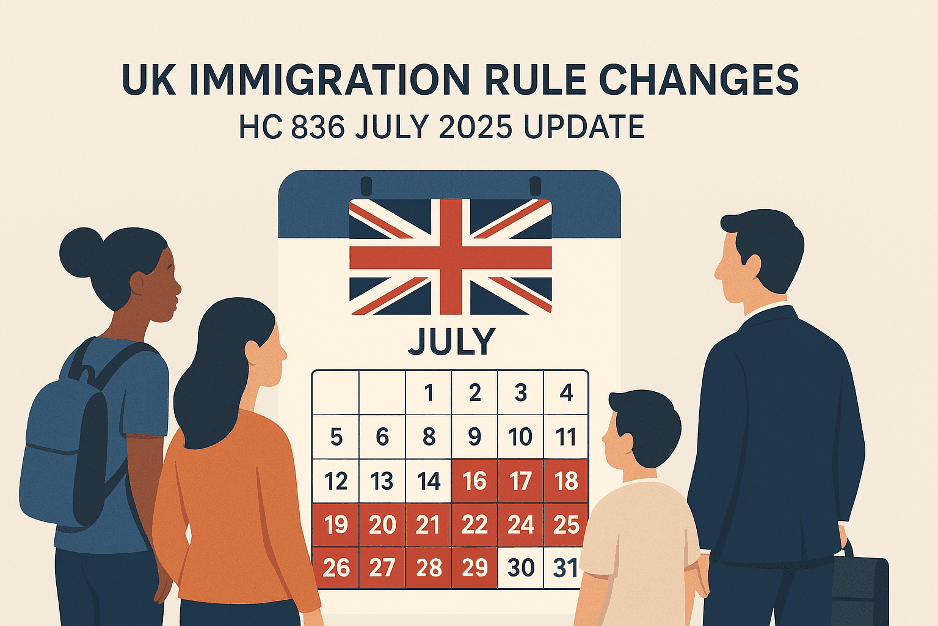
The landscape of UK immigration is ever-evolving, and staying informed is key to ensuring your journey is smooth and successful. The Home Office recently laid before Parliament the latest Statement of Changes to the Immigration Rules, HC 836, bringing significant updates that will take effect throughout July 2025.
These changes, staggered between the 16th and 29th of July, touch upon various crucial areas, including the EU Settlement Scheme, Private Life routes, Long Residence, and Continuous Residence. Whether you're an individual planning your future in the UK or an employer navigating workforce needs, understanding these amendments is paramount.
This guide breaks down the key upcoming changes in a clear, concise, and easy-to-understand format. Whether you're a visa holder, employer, or immigration adviser, it's essential to understand these changes and prepare accordingly.
2. Key Immigration Rule Changes Taking Effect in July 2025
a. EU Settlement Scheme (EUSS): A More Flexible Approach to Continuous Residence (Effective 16 July 2025)
Perhaps one of the most impactful changes for many, the definition of "continuous qualifying period" for pre-settled status holders under the EU Settlement Scheme is being updated.
●What's New?
Previously, strict absence limits (typically no more than six months in any 12-month period, with limited exceptions) could jeopardise an individual's path to settled status. From 16th July 2025, pre-settled status holders can qualify for settled status by demonstrating 30 months of presence within any 60-month period. This means more flexibility in how time in and out of the UK is counted.
● Why it Matters:
This is a welcome change for those who may have had legitimate reasons for extended absences, such as education, family commitments, or illness, and can prevent them from inadvertently losing their eligibility for settled status. The Home Office will apply this new test for both automatic upgrades and applications submitted from 16th July.
b. Restricted Leave and Part 9 Refusals: Stricter Rules for Exclusions (Effective 16 July 2025)
The rules surrounding individuals excluded from refugee or humanitarian protection are becoming more stringent.
● What's New?
For individuals excluded under specific paragraphs of the Immigration Rules (e.g., 339AA, 339AC, 339D, 339GB), restricted leave will now be the only form of leave granted. Any other application for leave will be mandatorily refused or cancelled.
● Why it Matters:
This reinforces the UK's stance on those deemed a danger or who have committed serious misconduct, ensuring they cannot gain alternative immigration pathways.
c. International Civilian Employees: Streamlined Border Access (Effective 17 July 2025)
A specific amendment is being made to facilitate the entry of certain US Department of Energy specialists and contractors.
● What's New?
Approximately 50 US Department of Energy federal employees and civilian sub-contractors supporting US Forces will be able to obtain a 60-day permission to enter the UK directly at the border, without prior entry clearance.
● Why it Matters:
This change aims to streamline and expedite urgent international cooperation on military equipment.
d. Appendix Private Life: Expanding Settlement Pathways (Effective 29 July 2025)
Positive changes are coming for certain individuals on the Private Life route, particularly young adults and children.
● What's New?
○ Young Adults:
Adults who were granted leave under the Family route or outside the rules before 20th June 2022 and meet the "half-life" test (having spent at least half their life in the UK) can now settle after five years, even if they turn 25 during that period.
○ Children:
Children granted dependent leave before 20th June 2022 who have lived in the UK for seven years will also qualify for settlement after five years.
○ UK-Born Children:
A new paragraph (PL 15A) will align continuous residence rules for UK-born children applying for settlement with those for children born abroad.
● Why it Matters:
These amendments aim to provide greater certainty and a clearer path to settlement for young people who have established a significant life in the UK.
e. Appendix Continuous Residence: Crown Dependencies Recognised (Effective 29 July 2025)
The Continuous Residence appendix has been largely rewritten for clarity, with one substantive update.
● What's New?
Time spent in the Crown Dependencies (Isle of Man, Jersey, or Guernsey) on an immigration route equivalent to a UK route will now count as lawful residence for UK settlement purposes.
● Why it Matters:
This provides more flexibility for individuals who have spent time in these regions while building their continuous residence towards settlement in the UK.
f. Appendix Long Residence: Clarification on Deprived Citizenship (Effective 29 July 2025)
A specific clarification is being made regarding British citizenship and its impact on Long Residence applications.
● What's New?
Where British citizenship has been deprived (e.g., due to deception), the time spent in the UK while holding that citizenship will no longer count towards a ten-year long-residence application.
● Why it Matters:
This ensures consistency and reinforces the consequences of citizenship deprivation.
g. Appendix Electronic Travel Authorisation (ETA): Broader Scope (Effective 16 July 2025)
The requirement for an Electronic Travel Authorisation (ETA) is being expanded to include new categories of travellers.
● What's New?
From 16th July, an ETA will be needed by:
○ Visitors (excluding Marriage/Civil Partnership Visitors) for stays up to six months.
○ Creative Workers entering under the Temporary Work – Creative Worker route for engagements up to six months.
○ People making a local journey from the Republic of Ireland after arriving there from outside the Common Travel Area, or after leaving the UK when their limited leave has expired (unless they are S2 Healthcare Visitors).
● Why it Matters:
This widens the scope of the ETA scheme, requiring more travellers to obtain this authorisation before their journey to the UK.
h. Appendix Student & Appendix Graduate: Dependant Rules Aligned (Effective 16 July 2025)
The rules for dependant partners on the Student and Graduate routes are being aligned with other Points-Based System categories.
● What's New?
A dependant partner will qualify only if the main applicant already has permission on the Student or Graduate route, or is applying concurrently and is granted permission. These routes now cross-refer to Appendix Relationship with Partner, making refusal mandatory if the main application is refused.
● Why it Matters:
This streamlines the dependant application process and ensures consistency across various visa categories.
i. Appendix Knowledge of Language and Life (KOLL): Updated Requirements (Effective 16 July 2025)
Changes are being made to how the English language and life in the UK requirements are met.
● What's New?
○ English Speaking Countries:
Malta is added to the list of majority English-speaking countries, and all British Overseas Territories are grouped under a single heading. Nationals from these countries meet the English language requirement without further evidence.
○ Overseas Degrees:
For overseas degrees, Ecctis must confirm comparability, and if the degree was awarded outside the named anglophone countries, Ecctis must also confirm the programme was taught or researched in English.
○ SELT Reuse:
A B1-level Secure English Language Test (SELT) taken for a previous successful grant of leave can now be reused, provided the provider remains on the approved list.
● Why it Matters:
These updates offer more flexibility for some applicants and clarify the evidence required for others, potentially simplifying the process for those with older SELT passes.
j. Appendix FM & FM SE: English Language Waiver & SELT Reuse (Effective 16 July 2025)
Further adjustments are being made to the English language requirements within the Family Migration routes.
● What's New?
The evidence accepted for the family route English language waiver is widened. For overseas degrees, if a certificate is delayed or unobtainable, an academic reference or official transcript may be submitted. Furthermore, a SELT previously accepted in any successful immigration route can now be reused for Appendix FM purposes, provided the test provider remains approved.
● Why it Matters:
These changes aim to remove common documentary hurdles and streamline repeat applications for individuals who have already demonstrated their English language proficiency.
3. How Can WorkPermitCloud Help?
At WorkPermitCloud, we understand how complex and stressful sudden immigration changes can be — especially when you’ve built your life or business plans around the existing rules.
WorkPermitCloud offers a Priority Service to help you face these deadlines. Submit Here Now!
Whether you're a Skilled Worker sponsor, a visa applicant, or an EU national navigating post-Brexit updates, we’re here to simplify the process for you.
📞 Call us: +44 020 8087 2343
📧 Email: info@workpermitcloud.co.uk
📅 Book a free consultation: calendly.com/lutfur-workpermitcloud
Let us help you stay informed, prepared, and supported through every step of your immigration journey.
4. Conclusion
The UK Government’s July 2025 Immigration Rule changes reflect a continued effort to modernise the system and close loopholes. These updates offer greater clarity for settlement applicants, new flexibility for EU nationals, and streamlined processes for partners and students. However, they also introduce stricter refusals and technical complexities.
If you are affected — or unsure how these rules impact your next steps — don’t navigate them alone. WorkPermitCloud is here to help you understand your options, stay compliant, and plan with confidence.
5. Glossary
Term | Definition |
| Statement of Changes HC 836 | The formal document laid before Parliament detailing the latest amendments to the UK's Immigration Rules, effective from various dates in July 2025. |
| EU Settlement Scheme (EUSS) | A scheme for EU, EEA, and Swiss citizens and their family members who were living in the UK by 31 December 2020 to secure their immigration status in the UK after Brexit. |
| Pre-settled Status | A temporary immigration status granted under the EUSS, usually for those with less than five years of continuous UK residence, which can later be upgraded to settled status. |
| Settled Status | A permanent immigration status granted under the EUSS, usually for those with five years or more of continuous UK residence, providing indefinite leave to remain in the UK. |
| Continuous Residence | A fundamental requirement for various settlement applications, referring to an unbroken period of lawful residence in the UK, subject to permitted absences. |
| Restricted Leave | A limited form of immigration permission granted to individuals who are excluded from refugee or humanitarian protection but cannot be immediately removed from the UK. This status typically comes with strict conditions and limited rights. |
| International Civilian Employees | A specific category of individuals, often linked to international agreements or military operations, whose immigration conditions are governed by particular rules to facilitate their work in the UK. |
| Appendix Private Life | A section of the Immigration Rules that sets out the requirements for individuals applying for permission to stay in the UK based on their private life established in the UK. |
| "Half-Life" Test | A term used in the context of Private Life applications, typically referring to individuals who have spent at least half their life residing in the UK. |
| Appendix Long Residence | A section of the Immigration Rules allowing individuals who have lived lawfully and continuously in the UK for a specified long period (usually ten years) to apply for indefinite leave to remain. |
| Electronic Travel Authorisation (ETA) | A digital permission for travellers who do not need a visa for short stays in the UK, similar to an ESTA for the USA. |
| Appendix Student | A section of the Immigration Rules detailing the requirements for individuals applying for a Student visa to study in the UK. |
| Appendix Graduate | A section of the Immigration Rules outlining the requirements for international students who have completed a degree in the UK to stay and work for a period after graduation. |
| Appendix Knowledge of Language and Life (KOLL) | A section of the Immigration Rules detailing the requirements for applicants to demonstrate their knowledge of the English language and life in the UK, often a prerequisite for settlement or citizenship. |
| Secure English Language Test (SELT) | An approved English language test required for certain UK visa applications to demonstrate language proficiency. |
| Ecctis | The UK national agency that provides expert advice and information on qualifications and skills from outside the UK. It often assesses overseas degrees for UK comparability. |
| Appendix FM & FM SE | Sections of the Immigration Rules relating to family migration, specifically for those applying to join family members in the UK (e.g., partners, children) and the financial and English language requirements associated with these routes. |
| Common Travel Area | An open borders area comprising the United Kingdom, Ireland, the Isle of Man, and the Channel Islands. |
| Crown Dependencies | Isle of Man, Jersey, and Guernsey — territories whose time under equivalent UK immigration routes can now count towards UK settlement. |
| Ecctis | UK’s designated agency for verifying international qualifications and English language proficiency. |
