
- Introduction: The UK Moves Toward a Digital Future
- What is the UK Digital ID Card Scheme?
- Why is the Government Introducing Digital ID?
- Implications for UK Employers: The Future of Right to Work Checks
- Preparing Your Business: 4 Essential Steps
- Addressing Common Concerns
- The Timeline: What Happens Now?
- How Can WorkPermitCloud Help?
- Conclusion
- Glossary
- Frequently Asked Questions
Introduction: The UK Moves Toward a Digital Future
The United Kingdom is planning a significant change in how identity and immigration status are verified. The government has announced plans to introduce a free national digital ID scheme for all UK citizens and legal residents, with a clear aim: to strengthen border control and streamline access to public and private sector services.
This new system, expected to be mandatory for Right to Work checks by the end of the current Parliament (likely 2029), is set to reshape compliance and onboarding processes for employers across the country. It promises a simpler, more secure method of verification, yet it also raises crucial questions for businesses and individuals alike regarding implementation, inclusion, and the future of existing systems like share codes.
Here at WorkPermitCloud (WPC), we understand that changes to immigration and HR compliance can be complex. This guide breaks down the UK Digital ID Card scheme—what it is, how it works, its benefits, and the essential steps employers need to take to prepare for this transformation.
What is the UK Digital ID Card Scheme?
The UK Digital ID is a new, secure digital identity for all UK citizens and legal residents. It will be a definitive, digital proof of who someone is and their residency status in the country, stored securely on the individual's smartphone via a dedicated GOV.UK digital wallet.
Key Features of the Digital ID:
● Free and Universal:
The ID will be free to obtain for all eligible individuals.
● Secure Storage:
Digital credentials will be stored on the user's own device, similar to the NHS App or contactless payment cards, using advanced encryption.
● Mandatory for Right to Work:
The most immediate and impactful change for businesses is that the Digital ID will become the mandatory way for employers to verify a new employee’s Right to Work status. This is a core part of the government’s strategy to tackle illegal working.
● Core Data:
It will include essential information such as:
○ Name
○ Date of Birth
○ Nationality or Residency Status
○ A Photo (for biometric security)
Why is the Government Introducing Digital ID?
The government is pursuing the Digital ID scheme with two main objectives: Security and Simplification.
Toughening Immigration Enforcement
The primary driver, particularly for the mandatory Right to Work element, is to curb illegal working. By making the digital ID the sole mandatory proof of eligibility to work, the government aims to:
● Deter Illegal Migration:
It sends a clear message that those who come to the UK illegally will not be able to obtain the necessary digital credential to find employment.
● Simplify Compliance:
It's designed to be a streamlined, authoritative check that will reduce reliance on easily forged paper documents, driving up employer compliance.
Enhancing Public and Private Services
Beyond immigration checks, the Digital ID is intended to improve daily life by making it easier and faster to prove identity for a host of services:
● Streamlined Access:
Provides one secure ID to access various services (e.g., welfare, free childcare, bank accounts) without needing to track down physical documents like passports, birth certificates, or utility bills.
● Reduced Fraud:
By providing only the necessary, verified information, it is expected to minimise identity fraud.
● Potential for Right to Rent:
While not yet confirmed, ministers have indicated that Right to Rent checks for landlords are also under review to be included in the mandatory rollout.
Implications for UK Employers: The Future of Right to Work Checks
The introduction of the Digital ID will necessitate a significant overhaul of current Right to Work processes.
Replacing the Current Mixed System
The direction of travel is towards a single, digital check that will eventually replace today's mixed system, which includes:
- Manual checks of physical documents (e.g., passports, BRPs).
- Digital Identity Service Provider (IDSP) checks for British and Irish citizens.
- Online Share Code checks for those with an eVisa or other digital status.
While the new system is being phased in, employers must be prepared for a period of overlap where both share codes and the new digital wallet checks may be in use. Ultimately, the Digital ID is likely to become the default and potentially sole verification method.
What Happens to Share Codes?
During the transition phase, share codes and eVisas will continue to be valid. The government has confirmed a phased rollout, meaning both systems will operate in parallel for several years.
Eventually, digital ID verification may replace share codes altogether, but this will depend on feedback from the upcoming public consultation and subsequent legislation. Employers should therefore plan for a period of overlap and update their onboarding and HR systems to accommodate both methods.
Employer Liability Remains
Crucially, the new system will not remove employer liability. Even with a simplified digital process, the statutory excuse—the defence against a civil penalty for employing an illegal worker—will still only apply if the employer completes the check exactly as prescribed and retains the required evidence.
Employers must be prepared to:
● Verify the Credential:
Check the government-issued credential from the applicant's GOV.UK wallet.
● Retain Evidence:
Update record-keeping policies to capture the evidence from the wallet check.
● Face Penalties:
The fines for employing an illegal worker remain severe, rising to £60,000 per illegal worker for repeat breaches. Proper compliance remains paramount.
Preparing Your Business: 4 Essential Steps
The best approach is proactive planning. Organisations that treat the consultation period as preparation time will be best placed to adapt seamlessly once the change becomes mandatory.
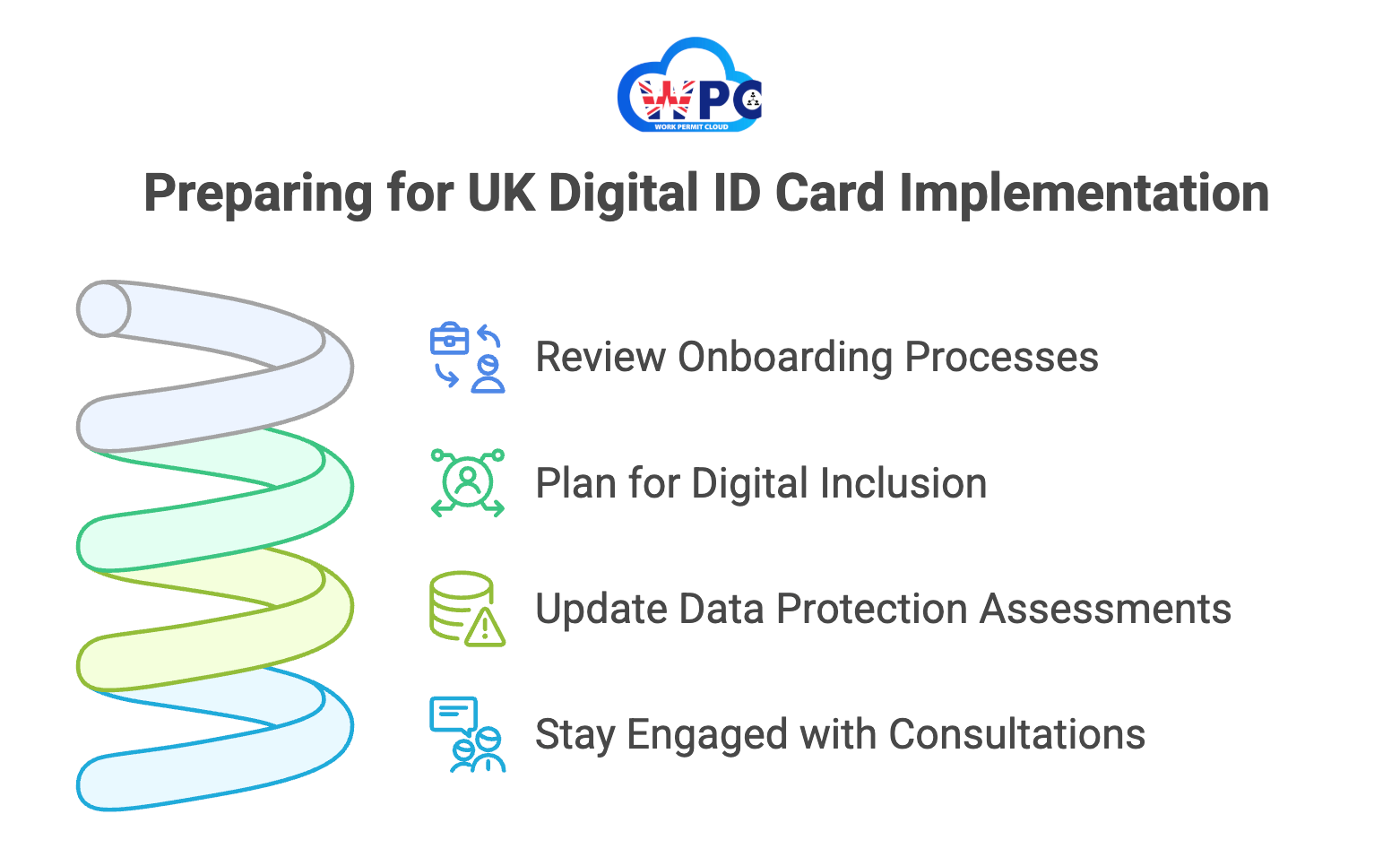
- Review Onboarding Processes: Map out your current hiring and onboarding journey. Identify where the new Digital ID check will be inserted and how it will interact with—or replace—your existing manual, IDSP, and share code checks.
- Plan for Digital Inclusion: The government intends for the scheme to be fully inclusive, providing physical alternatives and face-to-face support for those without smartphones or digital access. However, employers will still carry the responsibility for completing the check. Your plan must include alternative, compliant routes to ensure you can check the Right to Work status of all eligible candidates, without risk of discrimination.
- Update Data Protection Assessments: The Digital ID introduces new data flows and information storage requirements. Begin planning Data Protection Impact Assessments (DPIAs) to ensure your handling of this new type of personal data is compliant with UK GDPR.
- Stay Engaged with Consultations: The government is launching a public consultation later this year to finalise the scheme's details, scope, and rollout timeline. Stay informed about the outcomes of this consultation, as it will dictate the final rules and guidance you must follow.
Addressing Common Concerns
Naturally, a change of this scale brings up important questions. The government has provided clarity on several key points:
● Privacy & Security:
Your data will be stored on your own deviceaggio, not on a central government database. The system will use advanced encryption, and the government will not sell your data.
● Accessibility for All:
The government has committed to inclusivity. For those without a smartphone or who are not digitally confident, physical alternatives and face-to-face support will be available.
● Not a Police Tool:
The police will not have the power to conduct spot-checks or demand to see your Digital ID.
● For Travel:
You will still need your physical passport to travel abroad.
The government has promised an inclusive rollout with physical alternatives and caseworker support for those unable to use digital tools.
The Timeline: What Happens Now?
It's important to note that this change is not immediate. The existing Right to Work rules continue to apply for now. Here’s what to expect:
- Public Consultation (Late 2025): The government will launch a consultation to finalise the design, scope, and implementation plan.
- Phased Rollout: Following the consultation, a phased introduction is expected, leading to the mandatory use of Digital ID for Right to Work checks by 2029.
- Transition Period: Employers should anticipate a period where the current system (manual checks, share codes, and IDSPs) will coexist with the new Digital ID checks.
How Can WorkPermitCloud Help?
At WorkPermitCloud Ltd, we combine immigration expertise with advanced HR technology to help employers stay ahead of compliance changes.
Our HRMS and Right to Work App are already designed to integrate with digital verification methods — ensuring a smooth transition to the UK’s Digital ID system.
We help businesses:
● Assist with Right to Work checks and immigration compliance
● Maintain secure, audit-ready digital records
● Streamline onboarding while meeting Home Office standards
Ready to future-proof your compliance strategy? Get in touch with our experts today.
📞 Call us: +44 020 8087 2343
📧 Email: info@workpermitcloud.co.uk
📅 Book a free consultation: calendly.com/lutfur-workpermitcloud
Conclusion
The UK’s new Digital ID Card represents a turning point in identity management and immigration compliance. While it promises faster, more secure, and inclusive verification, success will depend on how well it’s implemented — and how employers adapt their systems in time.
By planning ahead and embracing compliance technology, organisations can not only avoid disruption but also gain efficiency and confidence in their hiring processes.
As the consultation progresses, one thing is clear: the future of Right to Work is digital, and preparation starts now.
Glossary
Term | Definition |
| Digital ID | A secure, government-issued digital credential that proves a person’s identity and residency/immigration status via the GOV.UK digital wallet. |
| GOV.UK Digital Wallet | The official mobile application that stores and presents a user’s Digital ID for verification, including Right to Work checks. |
| Right to Work (RTW) check | The legal process employers must complete to confirm a person is permitted to work in the UK before employment starts. |
| Statutory excuse | The legal defence an employer has against a civil penalty for illegal working, available only if RTW checks are completed exactly as prescribed and evidence is retained. |
| Share code | A one-time code generated from the Home Office system that lets employers view an individual’s digital immigration status online; expected to operate alongside Digital ID during transition. |
| eVisa | A digital record of a person’s immigration status that replaces physical BRP cards for many migrants. |
| BRP (Biometric Residence Permit) | A physical card historically used to evidence immigration status; increasingly replaced by eVisas and not valid once expired. |
| IDSP (Identity Service Provider) | A certified provider that can conduct digital identity checks for certain RTW scenarios (e.g., British/Irish passport holders) under current rules. |
| Digital exclusion | The risk that people without smartphones, connectivity, or digital skills are unable to use digital services; the scheme proposes alternatives and support. |
| Biometric authentication | Security methods that use physical characteristics (e.g., facial image) to help confirm identity within the Digital ID. |
| Device-based storage | A security approach where credentials are stored on the user’s phone rather than a central database, with revocation and reissue if the device is lost. |
| Encryption | The process of encoding information so only authorised parties can access it; used to protect Digital ID data in transit and at rest. |
| Data minimisation | The privacy principle of sharing only the minimum data needed for a specific purpose (e.g., proving work entitlement without excess personal details). |
| Audit trail | A record of when, how, and by whom a check was performed; essential for demonstrating compliance during audits or enforcement action. |
| DPIA (Data Protection Impact Assessment) | A formal assessment under UK GDPR to identify and mitigate privacy risks when introducing new data processing activities, such as Digital ID checks. |
| UK GDPR | UK data protection framework setting rules for lawful, fair and transparent processing of personal data. |
| Civil penalty | A fine imposed on employers for illegal working; currently up to £60,000 per illegal worker for repeat breaches. |
| Phased rollout | A staged implementation where Digital ID checks and legacy routes (manual/IDSP/share codes) operate in parallel before Digital ID becomes dominant. |
| Right to Rent (RTR) | Checks carried out by landlords/agents to confirm a tenant’s right to rent in England; potential future integration with Digital ID is under review. |
| Accessibility | Design features and alternative routes (e.g., face-to-face help, physical options) to ensure people with disabilities or limited digital access can still complete checks. |
