

Key Takeaways
- London employers have faced substantial fines for illegal working breaches.
- A Biometric Residence Permit (BRP) is no longer proof of right to work, and seeing an ARC card is not enough on its own to complete a right to work check.
- Expiry dates on cards do not always reflect actual visa status.
- ARC card holders usually require an Employer Checking Service (ECS) check.
- A share code alone does not give legal protection, the employer must complete and record the online check.
- A valid online check must be kept as a saved copy of the result showing the worker's photograph and the date of the check, with your business name recorded in full.
- Failure to follow specific procedures can lead to fines of up to £60,000 per illegal worker.
Introduction
London businesses have been hit with substantial fines for employing illegal workers. From restaurants to construction firms, the Home Office has drastically increased its enforcement activity.
But here is the most alarming part of the story: many of these employers didn’t intend to break the law. They thought they were compliant. They checked IDs, collected Share Codes, and filed paperwork. Yet, due to specific technical errors in how they conducted Right to Work checks, they were left with no legal defence and facing fines of up to £60,000 per employee.
At WorkPermitCloud, we regularly see businesses making the same avoidable mistakes, often relying on documents or share codes incorrectly. This guide explains what went wrong, what the law actually requires, and how you can protect your business. For the full process, including every check method and the documents you can accept, see our right to work checks guidance.
The BRP and ARC Card Trap
One of the most common misconceptions we see at Work Permit Cloud is the reliance on the physical card itself.
Many employers glance at an Application Registration Card (ARC) or an old Biometric Residence Permit (BRP), see a date on the card, and assume the check is complete. This is a dangerous error.
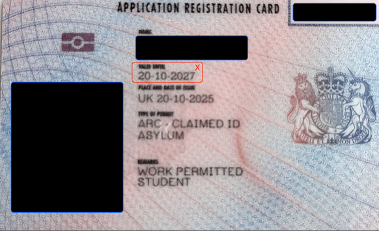
- The Date Myth: A validity date on a physical card does not always reflect the individual’s current visa status.
- ARC Cards: You cannot simply accept an ARC card. To establish a statutory excuse against a civil penalty, you must conduct an Employer Checking Service (ECS) check. Permission to work for an asylum seeker is also restricted to particular jobs: jobs on the Immigration Salary List or, for more recent applications, occupations skilled to RQF level 6 or above, depending on when they applied. The Positive Verification Notice confirms the work the person may do, so make sure the job matches it.
- BRP Cards: BRPs stopped being issued on 31 October 2024 and every BRP has now expired. A manual check of a BRP is not proof of right to work and gives you no statutory excuse. The holder has an eVisa, so you must check it online using their share code.
The "Share Code" Myth: Do You Have the Statutory Excuse?
Perhaps the most heartbreaking mistake involves the Share Code. Many employers believe that once a candidate emails them a share code, the job is done.
It is not.
Possessing a share code means nothing if you do not use it to generate the official Home Office report. To have a legal statutory excuse, you must visit the “Checking a job applicant's right to work” service portal, conduct the check and download the profile page. Crucially, you must check the "Details of check" box on that report.
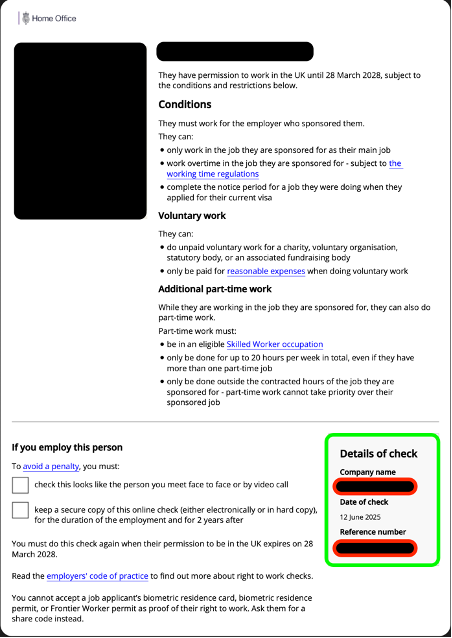
If your saved copy does not show:
- Company Name
- The Date of the Check
- The Worker’s Photograph
Then, in the eyes of the Home Office, you have not done the check. You are liable for a fine, even if the worker has the right to work.
Conclusion
The fines issued to London employers serve as a stark warning: the Home Office is not accepting "honest mistakes" as an excuse. Whether it is failing to verify an ARC card via the ECS or forgetting to download the full Share Code report, the cost of non-compliance is simply too high. Take a moment today to review your current processes, it could save your business thousands.
How Can WorkPermitCloud Help?
Navigating the nuances of Home Office compliance can be complex, and a single administrative slip-up can jeopardize your business's future. At WorkPermitCloud, we don’t just offer advice; we provide comprehensive compliance audits and Compliant HR system support to ensure your Right to Work checks are bulletproof. We help you verify that every share code, ECS check, and employee file meets the strict standards required to protect you from fines.
Get in touch with us today:
📞 Call us: +44 020 8087 2343
📧 Email: info@workpermitcloud.co.uk
📅 Book a free consultation: calendly.com/lutfur-workpermitcloud
Glossary
| Term | Definition |
| Right to Work Check | A legal process employers must follow to verify that a potential employee is permitted to work in the UK. |
| Statutory Excuse | The legal protection an employer gains against civil penalties by correctly following Home Office checking procedures. |
| BRP (Biometric Residence Permit) | A physical card that was issued to non-UK nationals as evidence of their immigration status until 31 October 2024. Every BRP has now expired and none is proof of right to work. Holders have an eVisa and must be checked online. |
| ARC (Application Registration Card) | A card issued to asylum seekers. It requires an additional ECS check to confirm working rights. |
| Share Code | A 9-character alphanumeric code generated by an employee to allow an employer to check their status online. |
| ECS (Employer Checking Service) | A Home Office service used by employers to verify the right to work for individuals with pending applications or ARC cards. |
| PVN (Positive Verification Notice) | A document issued by the ECS confirming that a specific individual has a temporary right to work. |